

Post Date:
Categories:
The European General Court (EGC) rules that a word with laudatory connotations may be registered as a trade mark if it does not specifically describe the goods and services and not all of its meanings are exclusively laudatory. (Judgement: T-611/13 of 15 July 2015)
[[{"type":"media","fid":"4538","view_mode":"media_large","instance_fields":"override","attributes":{"class":"media-image size-medium wp-image-2241 aligncenter","typeof":"foaf:Image","style":"","width":"300","height":"179"}}]]
Background of the Case and Subject Matter
On 13 August 2009, the World Intellectual Property Organisation (WIPO) approved the International Registration No. 0797277 of Effect Management & Holding GmbH for the word/device mark “HOT” for, in particular, cosmetics and sanitary products. The Office for Harmonisation in the Internal Market (OHIM) approved protection of the mark in the European Union on 26 November 2010 for Class 3 and 5. On 6 April 2011 the registration was challenged by Australian Gold LLC. They considered the mark to be purely descriptive and to lack a distinctive character. The Cancellation Division of OHIM partly upheld the cancellation action. The decision was appealed on 10 October 2012.
The question was whether the mark “HOT” is a laudatory term which exclusively describes certain characteristics of goods and services, or if it is laudatory in a broader sense i.e. if it refers to vague positive connotations without specifically referring to the goods and services themselves.
In the contested decision of 10 September 2013, the Fourth Board of Appeal declared that registration could only be rejected for “massage oils, gels” in Class 3 and “lubricant for pharmaceutical use” in Class 5. It was found that these goods are intended to be applied to the skin through repetitive motions, which creates a sensation of “heat”. For the remaining goods the Board ruled that the word “HOT” is neither descriptive nor lacks the necessary distinctiveness.
The Decision of the European General Court (EGC)
The EGC agrees that the mark “HOT” is descriptive for the goods “massage oils, gel” in Class 3 and “lubricant for pharmaceutical use” in Class 5. However, the Court rules that OHIM wrongfully concluded that the mark is not descriptive for “perfumes, essential oils, cosmetics” as “massage oils, gels” are mere examples of that broader category of goods, which is indicated by the word “including” within the list of goods in Class 3.
As for “washing and bleaching preparations; soaps” in Class 3 and “food supplements for medicinal purposes” in Class 5, the Court concludes that the word “HOT” is not describing the contested goods as it does not indicate the temperature of these goods. The positive connotations of the word “HOT” are too vague to create a direct link to these goods.
The Court refers to an earlier decision of the German Federal Court of Justice from 2014, where the word/device mark “HOT” was considered devoid of any distinctive character. The Court states that even though they may take rulings from national courts into consideration, they are in no way bound by their decisions.
On the contrary, the EGC makes an interesting statement regarding the distinctiveness of the mark. It rules that it is not sufficient in itself that the word “HOT” may have a sale promoting effect. In order to reject a mark it must be proven that the mark exclusively is a sale promoting slogan and thus lacks distinctiveness. The Court finds that Australian Gold LLC has failed to prove this as the word “HOT” has several meanings e.g. warm, spicy, appealing and attractive.
The European Court of Justice has in an earlier case ruled that it is sufficient for refusal of a trade mark that at least one of its possible meanings is descriptive in relation to the relevant goods and services (Doublemint C-191/01). The interpretation of the General Court in the “HOT”-case creates a tension with the earlier judgement. In addition, there have been some ambiguous results in earlier case law regarding registration of laudatory signs. This makes it hard to predict whether a laudatory sign will be considered sufficiently distinctive for registration in the future.
Post Date:
Categories:
The German Federal Court of Justice ruled on two aspects of trade mark law in its recent decision. The conclusion of the Court was, firstly, that a mark which is registered in black and white is not identical with a mark in colour unless the difference is insignificant. Secondly, the production of plaques consisting merely of a car producer’s trade mark falls within the monopoly granted by the exclusivity right of the trade mark proprietor. (Judgement: I Z 153/14 of 12 March 2015)
[[{"type":"media","fid":"4537","view_mode":"media_large","instance_fields":"override","attributes":{"class":"media-image size-thumbnail wp-image-2223 alignnone","typeof":"foaf:Image","style":"","width":"150","height":"150"}}]] vs. [[{"type":"media","fid":"4536","view_mode":"media_large","instance_fields":"override","attributes":{"class":"media-image wp-image-2222 size-thumbnail alignnone","typeof":"foaf:Image","style":"","width":"150","height":"143"}}]]
Background of the case and subject matter
The applicant, the well-known German car manufacturer, Bayerische Motoren Werke AG (BMW), is the proprietor of the registered German word/figurative mark No. 39644028 (on the left above). The mark is registered in black and white and is protected for, among other goods, plaques.
The defendant marketed spare parts for cars, both nationally and internationally. Among these parts were plaques (on the right above) sold by the defendant under the product description Repl. 5114 8 132 375. These plaques can be attached to the bonnet or tailgate of the cars produced by BMW.
BMW considered the plaques to be infringing their trade mark rights. The defendant, on the other hand, was of the opinion that it had a permissible spare part business, in which the use of brands was forcibly allowed. The Regional Court of Hamburg ruled in favour of the applicant and demanded the defendant to provide information on the use of the mark, to refrain from further sales of the plaques and to reimburse BMW’s damages caused by the defendant’s use (Judgement of March 22, 2011 312 O 366/10). The defendant appealed the judgement, but the Higher Regional Court of Hamburg dismissed the appeal and upheld the previous decision (Judgement of June 5, 2014 5 U 106/11). This decision was appealed to the German Federal Court of Justice.
The Decision of the German Federal Court of Justice (BGH)
The applicant successfully argued that the defendant’s plaques infringed BMW’s trade mark rights and the Court ruled that the applicant was entitled to the claims as ruled in the previous instances. However, the infringement could not be based on the German Trade Mark Act Sec. § 14 (2) No. 1 (which is implementing Art. 5 (1) of the Community Trade Mark Directive).
The German Federal Court of Justice stated that for the assessment of whether a trade mark infringement is present within the meaning of § 14 (2) No. 1 Trade Mark Act, only the trade mark registration and not the specific use of the trade mark on the goods are taken into consideration. BMW had only brought forward the mark which was registered in black and white, without relying on a coloured version.
The Court referred to a ruling of the European Court of Justice (LTJ Diffusion) where it was stated that “a sign is identical with a trade mark only where it reproduces, without any modifications or addition, all the elements constituting the trade mark or where, viewed as a whole, it contains differences so insignificant that they may go unnoticed by an average consumer”. An insignificant difference between two marks is a difference that a reasonably observant consumer will perceive only upon side by side examination of the marks.
Thus, the German Federal Court of Justice stated that a sign which is registered in black and white is not identical with a coloured version of the same sign, unless the difference in colour is insignificant. The overall impression of the plaque in question was predominantly characterized by the blue colour of two of the four central areas of the character, and the Court did therefore not find the plaque to be identical to the applicant’s protected mark. It was found to be significant variations in the colour schemes between the two marks.
This assessment corresponds to the controversial “Common Communication on the Common Practice on the Scope of Protection of Black and White Marks” of 15 April 2014, presented by the Office for Harmonisation in the Internal Market and national trade mark offices. The Communication does not determine the issue of identical signs for infringement cases, but, the German Federal Court made, through its ruling, sure that the question of identity is to be assessed according to the same principles for relative grounds for refusal and infringement issues.
Subsequently, the German Federal Court based the infringement of BMW’s trade mark rights on the likelihood of confusion under Sec. § 14 (2) No. 2 of the German Trade Mark Act. The goods in question were identical and the earlier mark enjoyed a high level of distinctiveness. The variations in colour schemes were not sufficient to prevent the finding of a high similarity of the signs.
Furthermore, the German Federal Court acknowledged that spare parts can only be sold if they include or can be equipped with the BMW plaque. In this case, the abbreviation “Repl” on the backside of the goods was not sufficient to indicate the intended purpose of the good as a spare part and thus engage the derogation for spare part businesses set out in Sec. § 23 No. 3 of the German Trade Mark Act. The majority of customers would not by this understand that the goods are not those of the trade mark proprietor’s. The Court ruled that the production of plaques consisting merely of the car producer’s trade mark itself falls within the monopoly granted by the exclusivity right of the trade mark proprietor.
Click here to read the full judgement of the German Federal Court of Justice.
Post Date:
Categories:
[[{"type":"media","fid":"4533","view_mode":"media_large","instance_fields":"override","attributes":{"class":"media-image wp-image-2206 alignright","typeof":"foaf:Image","style":"","width":"200","height":"118"}}]]
The Situation Report on Counterfeiting in the European Union (EU), prepared by Europol and OHIM through the European Observatory on Infringements of Intellectual Property Rights is a first try to capture the complex reality of counterfeiting in the EU in 2015.
1. Introduction
Intellectual Property Rights (IPR) make sure that innovators and creators receive profit for their work, encourage investment in research and create growth as well as quality jobs. IPR intensive industries account for more than a quarter of all jobs and more than a third of GDP in the EU. This demonstrates the important role of these rights for the economy and society in the EU, as well as the scale of potential damage that can be caused when they lose their value because of counterfeiting.
2. Spectrum of products
Counterfeited goods are no longer just poor quality clothing and accessories of luxury brands. Rather, counterfeited goods can be found in all sectors, such as pharmaceuticals, electronic goods, household products, cosmetics, automotive spare parts, pesticides, food and beverages.
This can be very dangerous for consumers: for example, cases of shampoo found to cause chemical burns to the scalp, cosmetics containing multiple unknown and sometimes toxic substances, and, using unlicensed or counterfeited batteries and laptop or phone chargers has resulted in explosions and fires.
3. Source countries of counterfeit goods
Not surprisingly, you can see below that the source country for over two thirds of counterfeit goods circulating in the EU is China. But, China is also a primary source country for the cheap production of legitimate goods.
As you can also see, the majority of source countries for counterfeits are outside the EU, although the report also underlined domestic EU production originating from Belgium, the Czech Republic, Spain, Italy, Poland, Portugal, and the UK.
[[{"type":"media","fid":"4534","view_mode":"media_large","instance_fields":"override","attributes":{"class":"media-image wp-image-2207 aligncenter","typeof":"foaf:Image","style":"","width":"372","height":"154"}}]]
A lot of the source countries are specialized in certain categories. For example India is focused on pharmaceuticals and Turkey on foodstuffs and cosmetics.
4. Transit of counterfeit goods
Products entering into Europe from the Far East and South East Asia mostly transit through Egypt, Hong Kong, Morocco, Singapore or the United Arab Emirates. These transit points are major hubs for shipping container traffic and have large free trade zones.
The counterfeiters abuse this world-wide infrastructure of 3.000 free trade zones in 135 countries for their business. Upon arriving, they change, document and relabel container loads to conceal the place of origin of the goods. Afterwards, they complete the manufacturing process by adding trademarks or packaging. This way the products reach the countries of sale.
5. Sales
Internet and e-commerce have become the most significant enablers for the distribution and sale of counterfeit goods because of its apparent anonymous character, its ability to operate across various jurisdictions, and its potential for presenting sophisticated replicas of official web shops.
6. Full Report[[{"type":"media","fid":"4535","view_mode":"media_large","instance_fields":"override","attributes":{"class":"media-image wp-image-2208 alignright","typeof":"foaf:Image","style":"","width":"91","height":"126"}}]]
For detailed information (including the above chart), please see this link with all of the statistics.
Post Date:
Categories:
[[{"type":"media","fid":"4529","view_mode":"media_large","instance_fields":"override","attributes":{"class":"media-image wp-image-2196 alignright","typeof":"foaf:Image","style":"","width":"131","height":"109"}}]]
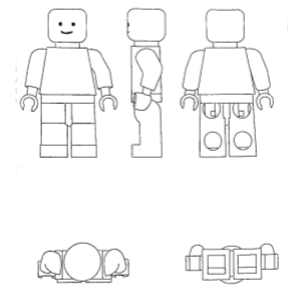
The European General Court (EGC) upholds the registrations of the shape of the Lego mini-figures as Community Trademarks (CTMs) (Judgments dated 16 June 2015; Cases T-395/14 and T-396/14).
Background of the Case and Subject Matter
On 18 April 2000, the Danish company Lego Juris A/S registered the following three-dimensional CTMs (No.: 000050450 and 000050518) with the Office for Harmonization in the Internal Market (OHIM) in respect of, inter alia, games and playthings. Bevor, these registrations, the mini figures were protected under a technical patent which was registered in the 1970s.
[[{"type":"media","fid":"4532","view_mode":"media_large","instance_fields":"override","attributes":{"class":"media-image aligncenter wp-image-2199","typeof":"foaf:Image","style":"","width":"502","height":"211"}}]]
In 2012, the British competitor Best-Lock, which uses similar mini - figures since 1998, applied for a declaration of invalidity relating to all of the goods protected by the CTMs. The application was based on the fact that the shape of the goods in question is determined by the nature of the goods themselves. Furthermore, Best-Lock is of the opinion that the toy figures in question, both as a whole and in their particulars, involve a technical solution because the shape of the mini - figures are determined by the fact that they are part of a toy that involve “interlocking building blocks for play purposes”.
OHIM rejected the applications for a declaration of invalidity. Therefore, the toy manufacture Best-Lock applied to the EGC for annulment of OHIM’s decisions.
Decision of the Court
The EGC dismissed Best-Lock’s appeal.
First of all, the EGC rejects the complaint that the shape of the goods in question is determined by the nature of the goods themselves because Best-Lock has not put forward any arguments to support that assertion.
Moreover, the EGC came to the result that the key elements (heads, bodies, arms and legs) of the shape of the mini - figures did not actually involve the ability to join them to other building blocks. Particularly, the graphical representation of the hands of the figures, the protrusion on their heads and the holes under their feet and inside the backs of their legs do not necessarily enable it to be known whether those components have any technical function and, if so, what that function is. Therefore, the EGC came to the result that there is no evidence which prove to permit the inference that the shape of the mini - figures is, as such and as a whole, necessary to enable the figures to be joined to interlocking building blocks.
Moreover, the court is convinced that the purpose of the shape is just to confer human traits on the mini - figures. These are necessary because the figures represent characters which are used by children in an appropriate play context.
Consequently, the EGC concludes that the characteristics of the shape of the figures in question are not necessary to obtain a technical result.
![[[{"type":"media","fid":"4532","view_mode":"media_large","instance_fields":"override","attributes":{"class":"media-image aligncenter wp-image-2199","typeof":"foaf:Image","style":"","width":"502","height":"211"}}]]](/sites/default/files/2015/07/lego-4_1.png)
Post Date:
Categories:
[[{"type":"media","fid":"4528","view_mode":"media_large","instance_fields":"override","attributes":{"class":"media-image aligncenter size-medium wp-image-2189","typeof":"foaf:Image","style":"","width":"300","height":"300"}}]]
This year LexDellmeier is for the first time a part of the European Law Students’ Association’s Student Trainee Exchange Programme.
The European Law Student’s Association (ELSA) is an international, independent, non-political, non-profit-making organisation run by and for students with over 40.000 members at nearly 300 faculties throughout 43 countries in Europe. ELSA provides for the Student Trainee Exchange Programme (STEP), which is an outstanding opportunity for law students and young lawyers to gain practical legal experience abroad and to get to know the culture of another country. This year LexDellmeier has decided to accept two interns from another country, each for a period of three months
I therefore have the pleasure to be LexDellmeier’s intern from mid-July to mid-October 2015. My name is Elisabet Høines Totland and I am currently in my fifth year of law school in Bergen, Norway. I was introduced to Intellectual Property Law during my exchange semester in the Netherlands. Studying IP law made me eager to enhance my knowledge and to work more within this field of law. Throughout law school I have aimed to work in an international atmosphere, and I thus seized the opportunity when the IP law firm LexDellmeier offered an internship in the IP capital of Europe. I am eager to get started and to learn more about German and European IP law through conducting research and supporting the lawyers in the firm and writing interesting articles for this blog.
If you are interested in becoming a part of the STEP Programme, you can check out http://elsa.org/page/traineeships/ for more information.
Post Date:
Categories:
The European General Court (EGC) dissmissed the appeal of the Swatch AG against the Community Trademark (CTM) application “SWATCHBALL“ by Panvision Europe Ltd (Judgment dated 19 May 2015; Case No.: T‑71/14).
Background of the Case and Subject Matter
On 24 December 2007, Panavision Europe Ltd filed an application for registration of a Community Trademark at the Office for Harmonization in the Internal Market (OHIM). The mark in respect of which registration was sought is the word mark “SWATCHBALL” for –among others – lighting and photographic equipment. The Community Trademark application was published in Community Trademarks Bulletin No 24/2008 of 16 June 2008.
On 15 September 2008, the applicant, Swatch AG, filed a notice of opposition which was based on the following earlier marks:
- The international word mark “SWATCH” (No: 469 696) and the Community trademark “Swatch” (No: 226 019) for - among others - “clocks and watches”.
- The international word/device mark (left below) (No: 614 932; 506 123, 226 316) for – among others – watches and jewellery.
Decisions of the previous instance
On 13 January 2012, the Opposition Division rejected the opposition in its entirety. On 9 March 2012, the applicant filed a notice of appeal with OHIM against the decision of the Opposition Division.
By decision of 11 November 2013, the Second Board of Appeal of OHIM (BoA) dismissed the applicant’s appeal. Firstly, the court was of the opinion that there is no likelihood of confusion as the goods and services at issue are dissimilar.
Secondly, the court came to the conclusion, that the earlier marks may have a reputation in the French, German and Spanish markets for watches and clocks, but, the goods and services at issue are so different, that the mark applied for is unlikely to bring the earlier marks to the mind of the relevant public.
Thirdly, the BoA found that the applicant had failed to prove that use of the mark applied for in relation to the goods and services covered by it could cause a dilution of the earlier marks through the dispersion of their identity and their hold upon the public mind or take unfair advantage of the reputation or distinctive character of the earlier trademarks.
Decision of the EGC
The EGC dismissed the appeal of the Swatch AG.
The Court ruled, that three cumulative conditions must be met in order to create likelihood of confusion if goods and services of opposing trademarks are not similar: First, the respective marks must be similar or identical; secondly, the earlier mark must have a reputation; thirdly, there must be a risk that the use, without due cause, of the later mark could take unfair advantage of or be detrimental to the distinctive character or the repute of the earlier mark.
In the present case, the EGC acknowledged that the first and the second conditions were fulfilled: “SWATCHBALL” includes the whole of the reputational word mark “SWATCH”.
However, with respect to the risks required by the third condition, those risks are based on the similarity of the trademarks and become real when the relevant public creates a link between the marks so that the later mark recalls the earlier one, without it being necessary for them to be confused. The EGC came to the result that such a link does not exist between “SWATCH“ and “SWATCHBALL“ because the goods and services protected by the respective marks were too different. The relevant public of “SWATCHBALL” is specialized in the field of lighting, optical, lighting and photographic equipment and other visual effects, whereas, the trademark “SWATCH” is addressed to the general public. Therefore, the opposing trademarks have different distribution channels and purposes and belong to separate market sectors, thus they are not in competition at all.
![[[{"type":"media","fid":"4527","view_mode":"media_large","instance_fields":"override","attributes":{"class":"media-image alignnone wp-image-2180","typeof":"foaf:Image","style":"","width":"141","height":"46"}}]]](/sites/default/files/2015/06/swatch_korrigiert_0.png)
Post Date:
Categories:
[[{"type":"media","fid":"4524","view_mode":"media_large","instance_fields":"override","attributes":{"class":"media-image alignnone wp-image-2167 alignright","typeof":"foaf:Image","style":"","width":"143","height":"122"}}]]
The European General Court (EGC) decided that the decision of the BoA has to be annulled, but not altered because it did not mention an earlier decision of a Community Trademark (CTM) court (Judgment dated 25 March 2015; Case No.: T‑378/13).
Background of the Case and Subject Matter
On 13 October 2009 Carolus C. BVBA filed an application for registration of a CTM at the Office for Harmonization in the Internal Market (OHIM). The trademark for which registration was sought for was the word mark “English Pink“ for - among others - fresh fruits. The application for a CTM was published in the CTM Bulletin No 2010/014 of 25 January 2010.
On 20 April 2010, Apple and Pear Australia Ltd and Star Fruits Diffusion filed a notice of opposition which was based on the word mark “PINK LADY“ (CTM No. 2042679) for - among others – fresh fruits, especially apples and the Community word/device marks (CTMs No. 4186169 and 6335591 ) you can see below for the same goods.
PINK LADY & [[{"type":"media","fid":"4526","view_mode":"media_large","instance_fields":"override","attributes":{"class":"media-image alignnone size-full wp-image-2169","typeof":"foaf:Image","style":"","width":"225","height":"94"}}]] & [[{"type":"media","fid":"4525","view_mode":"media_large","instance_fields":"override","attributes":{"class":"media-image alignnone size-full wp-image-2168","typeof":"foaf:Image","style":"","width":"138","height":"133"}}]]
![[[{"type":"media","fid":"4526","view_mode":"media_large","instance_fields":"override","attributes":{"class":"media-image alignnone size-full wp-image-2169","typeof":"foaf:Image","style":"","width":"225","height":"94"}}]]](/sites/default/files/2015/06/pink-lady_1.png)
![[[{"type":"media","fid":"4525","view_mode":"media_large","instance_fields":"override","attributes":{"class":"media-image alignnone size-full wp-image-2168","typeof":"foaf:Image","style":"","width":"138","height":"133"}}]]](/sites/default/files/2015/06/english-pink_1.png)
vs.
English Pink
Decisions of the Previous Instance By decision of 27 May 2011 the Opposition Division rejected the opposition. On 7 June 2011 the trademark owners filed an appeal with OHIM against the decision of the Opposition Division. In 2012, before adopting the contested decision, the Board of Appeal (BoA) was informed about final judgment of the Belgian CTM Court Tribunal de Commerce de Bruxelles (TCB) cancelling the Benelux mark “ENGLISH PINK“ because of likelihood of confusion with the earlier “PINK LADY“ CTM and Benelux trademarks. The TCB found that the Benelux mark “ENGLISH PINK“ infringes the “PINK LADY“ marks and prohibited the other party from using the sign “PINK LADY“ within the EU. The TCB ruled that the “PINK LADY” CTMs enjoy a high degree of protection and that there is a significant likelihood of confusion between “PINK LADY” and “ENGLISH PINK”. By decision of 29 May 2013 the BoA dismissed the appeal. The court was of the opinion that the marks were not visually, conceptually or phonetically similar and therefore there is no likelihood of confusion. The BoA was also of the opinion that the opponents had failed to establish the reputation of their earlier word mark and had not shown that the public associated “PINK LADY” with them rather than with apples of that variety as produced by any other grower. In reaching its decision, the BoA only referred to the evidence before the Opposition Division. Decision of the Court The EGC annulled, but did not alter the decision of the BoA. First, the EGC came to the result that although the BoA had been duly informed numerous months before the adoption of its decision about the judgment of the TCB, it did not even mention it. According to the EGC, the submission of facts and evidence by the parties remains possible even after the expiry of the time-limits and OHIM is in no way prohibited from taking account facts which are submitted or produced at a later stage. Therefore, the judgment of the TCB was a relevant factual element to be taken into account in this case, especially, in view of the fact that there were essential common points between the elements at issue in the Belgian infringement proceedings and the opposition proceedings: - The parties to both sets of proceedings were identical. - The earlier word mark relied on in support of the infringement proceedings before the TCB was the same as that relied on in support of the opposition proceedings before OHIM. - This judgment was delivered by a CTM court which was established as part of the autonomous system that underlines the European Union's trademark regime. As a result, the EGC is of the opinion that the BoA did not assess all the relevant factual aspects of the case with the required diligence. This lack of diligence was such as to lead to annulment of the BoA’s decision. Finally, the EGC pointed out that the judgment of the TCB is not in itself sufficient to enable the EGC to alter the contested decision. When exercising its exclusive jurisdiction over registration of CTMs and when examining oppositions lodged against CTM applications, the Office is not bound by a decision of a CTM court delivered in an action for infringement. The unitary character of the CTM does not mean that the principle of res judicata precludes the departments of OHIM and, consequently, the European Union Courts, from examining the possible existence of a likelihood of confusion in the context of opposition proceedings concerning the registration of a new CTM, even though it is identical to a national mark which has been held by a CTM court to undermine the earlier CTM.
Post Date:
Categories:
The European General Court (EGC) decided that the chequerboard pattern device mark of Louis Vuitton is not distinctibe and therefore has to be declared null and void (Judgment dated 21 April 2015; Case No.: T‑360/12).
Background of the Case and Subject Matter
On 4 January 2008, the applicant, Louis Vuitton Malletier, filed a Community Trademark (CTM) application for a “chequerboard pattern”at the Office for Harmonization in the Internal Market (OHIM) for bags and luggage (see below). On 21 November 2008 the applicant was granted registration of the abovementioned device mark under CTM No 6587851.
On 28 September 2009, the intervener, Nanu-Nana Handelsgesellschaft mbH für Geschenkartikel & Co. KG, a German company, filed an application for a declaration of invalidity relating to all of the goods protected by the registration of the CTM. That application was based on the fact that the contested trademark is descriptive and devoid of any distinctive character, that it has become customary in the current language or in the bona fide and established practices of the trade, that it consisted exclusively of the shape which gives substantial value to the goods and that it was contrary to public policy or to accepted principles of morality. The intervener also claimed that the applicant had acted in bad faith when filing the application for the trademark.
By decision of 11 July 2011 the Cancellation Division confirmed the invalidity.
The Cancellation Division held that the CTM consisted of a chequerboard pattern with a weft and warp structure intended to be applied to the surface of the goods in question. It went on to hold that that pattern was one of the most basic patterns used as a decorative element, and as such the relevant public would see it as merely a decorative feature and not as an indication of the origin of the goods in question and that, in any event, the contested trademark did not depart significantly from the norms or customs of the sector. In addition, it considered that the documents submitted by the proprietor of the CTM did not prove that, at the date of filing or after its registration, the CTM had acquired distinctive character through the use which had been made of it in at least 8 of the 27 Member States of the European Union (EU). The Cancellation Division concluded that that lack of evidence as regards those States was sufficient to find that the applicant had not established that distinctive character had been acquired through use.
On 9 September 2011 the applicant filed a notice of appeal against the decision of the Cancellation Division. By decision of 16 May 2012, the First Board of Appeal (BoA) of OHIM upheld the decision of the Cancellation Division and thus dismissed the appeal.
The BoA ruled, that the chequerboard pattern is a basic and banal feature composed of very simple elements and that it is well-known that that feature had been commonly used with a decorative purpose in relation to various goods. The BoA went on to hold that the trademark, in the absence of features capable of distinguishing it from other representations of chequerboards, is not capable of fulfilling the essential function of a trademark to indicate the origin. Furthermore, the BoA considered that the weft and warp structure of the contested trademark did not constitute a substantial feature of that trademark and did not give it a distinctive character. Furthermore, the fact that the weft and warp structure of that trademark had been copied does not demonstrate that it acted as an indication of commercial origin for the relevant public. The BoA consequently is of the opinion that the trademark is very simple and contains no element capable of individualizing it in such a way that it would not appear as a common and basic chequerboard pattern. Furthermore, the court added that signs such as the contested trademark were typically used as supplementary signs which coexisted beside the manufacturer’s house mark. As a result the BoA decided that the trademark was devoid of any distinctive character.
Finally, the BoA come to the conclusion, that the documents produced by the proprietor of the contested trademark did not demonstrate that the relevant public would be in the habit of making an assumption on the commercial origin of the goods at hand based on patterns. The court considered, that on the basis of the evidence provided by the applicant, it had not been established that the contested trademark had acquired distinctive character through the use which had been made of it in a substantial part of the relevant territory.
Decision of the Court
The EGC confirmed the earlier decisions, and therefore consequently, dismissed the appeals of Louis Vuitton.
First of all, the EGC is of the opinion that the trademark lacks distinctive character. The Court applied the case-law on the assessment of inherent distinctiveness of 3D and word/device marks which coincide with the appearance of the products, according to which consumers perceive those signs as commercial origin identifiers with some difficulty if they do not bear any graphic or word elements, unless they depart from the norms and customs of the sector. The chequered board patterns are not fulfilling these conditions because they are too basic, too common and lack any specific character. Moreover, they are used very often for decorative purposes on bags and luggage.
Secondly, the court is of the opinion, that a CTM must have distinctiveness throughout the EU given the unitary character of CTMs. It follows that a CTM cannot be registered if it is not distinctive in parts of the EU. Nevertheless, CTMs can acquire distinctive character through use either at the time of filing or after registration in order for them not to be vulnerable to a validity challenge.
The EGC held that the BoA correctly made the overall assessment of the evidence provided by Louis Vuitton which, however, could not lead to the conclusion that its marks had acquired distinctive character because of the use made of them in the relevant periods of time and in all the territories in which the marks were not deemed to be inherently distinctive - in these cases the entire EU. Indeed, unless Louis Vuitton could have proved the contrary, the assessment of their distinctiveness was to be the same in the entire EU, and both were deemed to lack distinctive character ab initio in all Member States.
As a result of these, the trademark has to be declared null and void.
![[[{"type":"media","fid":"4523","view_mode":"media_large","instance_fields":"override","attributes":{"class":"media-image alignnone size-full wp-image-2162","typeof":"foaf:Image","style":"","width":"186","height":"177"}}]]](/sites/default/files/2015/05/louis-vuitton_1.png)
Post Date:
Categories:
The EGC decided that a likelihood of confusion between the word device/mark “Skype” and the word mark “SKY” exists (Judgment dated 5 May 2015; Case No.: T‑184/13).
Background of the Case and Subject Matter
On 28 June 2005, Skype Ultd., which now belongs to Microsoft, filed for a Community Trademark (CTM) Application at the Office for Harmonization in the Internal Market (OHIM) for the word/device mark “Skype” (see right below). The CTM Application was published in the Community Trademarks Bulletin No 21/2006 of 22 May 2006.
[[{"type":"media","fid":"4522","view_mode":"media_large","instance_fields":"override","attributes":{"class":"media-image alignnone wp-image-2158","typeof":"foaf:Image","style":"","width":"620","height":"123"}}]]
Afterwards, on 21 August 2006, the interveners, British Sky Broadcasting Group plc, now Sky plc, and Sky IP International Ltd, filed a notice of opposition against the trademark applied for. The opposition was based, in particular, on the earlier CTM “SKY”, which was filed on 30 April 2003 and registered on 14 October 2008.
On 16 November 2010, the Opposition Division upheld the opposition. On 11 January 2011, the applicant filed a notice of appeal with OHIM against the Opposition Division’s decision.
By decision of 30 January 2013, the Fourth Board of Appeal of OHIM (BoA) dismissed the appeal. In particular, it found that the goods and services covered by the trademarks at issue were identical and that there was an average degree of visual, aural and conceptual similarity between the marks at issue. The BoA is of the opinion, that the SKY brand enjoys a high degree of distinctiveness in the United Kingdom and the degree of its distinctiveness is average for the remaining goods and services at issue. Consequently, the BoA found there to be a likelihood of confusion, even taking into account a possible higher degree of attention of the relevant consumer. Moreover, the conditions for establishing a reduction in the likelihood of confusion on account of a peaceful coexistence of the marks on the market were not fulfilled in this case.
Decision of the Court
The European General Court (EGC) dismissed Skype’s appeal. The EGC is of the opinion that there exists a likelihood of confusion between the word/device mark “Skype” and the word mark “SKY”.
Regarding the visual, phonetic and conceptual similarity of the signs at issue, the EGC has confirmed that the pronunciation of the vowel “y” is not shorter in the word “Skype” than it is in the word “Sky”. In addition, the word “Sky” is part of the basic vocabulary of the English language and remains clearly identifiable within the word “Skype”, in spite of the fact that the latter is written as only one word. Finally, the element “Sky” in the word ”Skype” can perfectly well be identified by the relevant public, even if the remaining element “pe” has no specific meaning.
Furthermore, the fact that, in the word/device mark applied for, the word element “Skype” is surrounded by the shape of a cloud or a bubble does not affect the average degree of visual, phonetic and conceptual similarity. Visually, the figurative element does only highlight the word element. Phonetically, the figurative element has no meaning. Conceptually, the figurative element conveys no concept, except perhaps that of a cloud, which would further increase the likelihood of the element “Sky” being recognized within the word element “Skype”, for clouds are to be found.
The EGC also does not accept the argument that the “Skype” signs are highly distinctive because they are known by the public. Rather, the Court declares that, even if the term ”Skype” had acquired a meaning of its own for identifying the telecommunications services provided by the company Skype, it would be a generic, and consequently descriptive, term for services of that kind.
In conclusion, the EGC rejected the applicant’s argument based on a supposed peaceful coexistence between the trademarks. The EGC noted, first, that the coexistence of the trademarks at issue in the United Kingdom can concern only peer-to-peer communication services and therefore, cannot lessen the likelihood of confusion in respect of the many other goods and services covered by the signs. In addition, the coexistence has not lasted long enough to give grounds for the assumption that it was based on the absence of any likelihood of confusion in the mind of the relevant public.
![[[{"type":"media","fid":"4522","view_mode":"media_large","instance_fields":"override","attributes":{"class":"media-image alignnone wp-image-2158","typeof":"foaf:Image","style":"","width":"620","height":"123"}}]]](/sites/default/files/2015/05/skype1_1.png)
Post Date:
Categories:
[[{"type":"media","fid":"4520","view_mode":"media_large","instance_fields":"override","attributes":{"class":"media-image wp-image-2150 alignright","typeof":"foaf:Image","style":"","width":"170","height":"118"}}]]
The European Court of Justice (ECJ) decided that the language selection of the European Patent Court is no discrimination (Judgment dated 05 May 2015; Case No.: C-147/13).
Background of the Case and Subject Matter
The Kingdom of Spain claims infringement of the principle of non-discrimination on the ground of language since the regulation establishes, with respect to the European patent with unitary effect (EPUE), a language arrangement which is prejudicial to individuals whose language is not one of the official languages of the European Patent Office, which are English, French and German. Spain submits that any exception to the principle that the official languages of the European Union have equal status ought to be justified by criteria which are other than purely economic.
Decision of the Court
The ECJ recognizes that the regulation differentiates between the official languages of the EU. But, it emphasizes that the regulation has a legitimate objective, namely the creation of a uniform and simple translation regime for the EPUE so as to facilitate access to patent protection, particularly for small and medium-sized enterprises. The complexity and particularly high costs of the current European patent protection system constitute an obstacle to patent protection within the EU and affect adversely the capacity to innovate and compete of European businesses, particularly small and medium-sized enterprises. The Court emphasizes that the language arrangements established by the regulation give access to the EPUE and the patent system as a whole easier, less costly and legally more secure. The regulation is also perfectly executed, as it maintains the necessary balance between the interests of applicants for EPUEs and the interests of other economic operators.