

On Wednesday, 17 June 2020, LexDellmeier held its fifth webinar on the topic “Brand Value and Financial Instruments”. During a 30 minutes discussion, Alexandra and Oliwia outlined the concepts of “brand valuation” and “brand evaluation” and explained how the economic value of a brand is assessed. If you missed the webinar, don’t worry – we recorded it and published on YouTube! As usual, you’ll find the link in the post below.

You might have heard that in 2020 Amazon - the world’s most valuable brand - exceeded US$ 200 billion value mark. But have you ever wondered where this number comes from? Or in other words, how the economic value of a brand is assessed?
Well, the starting point is that in the past 10 – 15 years businesses have seen a fundamental shift in the sources of value creation from their tangible assets to their intangible assets, namely intellectual property (brand). As a result, it became more important than ever to develop some objective standards according to which the value of brands could be assessed.
This task was undertaken by ISO – International Organization for Standardization, which is a non-governmental body that aims to facilitate world trade by providing common international standards for goods and services. Although mostly known for regulating things such as the shape of phone plugs or size of paper sheets, it also set standards for brand valuation (ISO 10668) and brand evaluation (ISO 20671). These two standards include inter alia guidelines as to what financial and non-financial methods should be used in the process of brand valuation and brand evaluation in order to achieve an objective assessment of a brand’s economic performance.
So, if you want to learn more about brand valuation and brand evaluation, understand the benefits of these two processes, and find out why people buy Coca Cola even though they actually prefer the taste of Pepsi, make sure to watch our Webinar! We also encourage you to take a look at the reports that we used as information sources, in particular the INTA Brand Value Special Task Force Report 2020 and PWC Brand Surveys 2012 (English) & 2019 (German). You’ll find the links to both of them at the end of our PowerPoint presentation.
PowerPoint presentation to download (PDF):
[[{"type":"media","fid":"5176","view_mode":"default","instance_fields":"override","link_text":"20200617_final_presentation_webinar_5_brand_value_financial_instruments_en.pdf"}]]
Link to the recording on YouTube:
https://www.youtube.com/watch?v=ZDZeNlAXeKw
Content of the webinar “Brand Value and Financial Instruments”:
- What is the economic value of a trademark?
- Assessing the value of a brand
- Key definitions
- International Organization for Standardization -Overview
- ISO Standards
- Brand valuation
- Importance
- Financial instruments
- Process
- Brand evaluation
- Framework & Importance
- Case Studies
Wanna cool down? Enjoy some “Plombir”! It is summer. The sun is shining, it is hot and you are looking for something to cool down a bit. How about a “Plombir”? You do not know what “Plombir” is? It is a kind of ice-cream that is very popular in the Russian Federation. But instead of only being used to COOL people down, it has been the subject of HEATED debates at the EUIPO and in Germany over the past about 10 years regarding the question whether or not the term “Plombir” was descriptive for ice-cream. Here is what the European Court of Justice (ECJ) decided on 18 June 2020.

(source: Shutterstock.com, No. 1280544706)
1. Background
The German company Dovgan GmbH is the owner of several word and figurative trademarks containing the term “Plombir” in Germany and at the EUIPO. The trademarks are mainly registered in classes 29 and 30 for, among others, edible ice-cream and the goods are sold widely across Germany.
Based on its registered trademarks, Dovgan GmbH tried prohibiting use of the word “Plombir” by third parties and the mark became the subject of invalidity proceedings. It was claimed that the word “Plombir” should not be monopolized, but needed to be kept available for the public, particularly for trade and export. It was asserted that the contested mark was the transliteration into Latin characters of the Cyrillic word “Пломбир”, meaning “ice-cream” in Russian. Thus, it was purely descriptive for edible ice-cream and could not serve as a registered trademark.
The cancellation proceedings kept the trademark offices and courts busy over several years.
2. Decision
German and European Union trademark law provides that signs or indications that may serve, in trade, to designate characteristics of the goods or services for which trademark registration is sought, may be freely used by all. The provision aims to prevent monopolizing the use of a descriptive term to the detriment of other undertakings, including competitors, for whom the extent of the vocabulary available to describe their own products would be reduced.
The descriptive character of a sign must be assessed in relation to the goods or services concerned and in relation to the perception of the public targeted, which is composed of the consumers of those goods or services in the European Union – or “part of the Union”. Also, “Part of the Union” is to be determined on a case to case basis. It can be a Member State or a group of Member States of the European Union. But, as the ECJ now confirmed in the most recent decision dated 18 June 2020 regarding “Plombir” ice-cream, the term “part of the Union” can also apply to a territory smaller than the territory of a Member State.
In the same decision, the court had to determine if the word “Plombir” in Latin characters was understood by the relevant public in the EU as describing ice-cream. The issue was that Russian is not an official language of the European Union. However, the ECJ held that the descriptive character of the trademark “Plombir” should be examined from the point of view of Russian speaking consumers who are members of the general public of the EU and reside, in particular, in Germany and the Baltic States as “part of the Union”. In this context, the court confirmed that it was a well-known fact that a significant proportion of Baltic State nationals know Russian or speak it as their mother tongue. Also, the court agreed with the cancellation applicant that the Russian-speaking public in the European Union was likely to use means of communication which cannot process Cyrillic characters and that it was therefore accustomed to transliterating Russian words into Latin characters. Taking all that into account, the court found that as the word ‘plombir’ constitutes a faithful transliteration of the word ‘Пломбир’ into Latin characters known to the relevant Russian-speaking consumer in the EU, its descriptive meaning will be immediately and directly understood by that consumer.
Overall, the court thus confirmed that the evidence provided by the cancellation applicant had sufficiently proved that, in the European Union, the term “Plombir” was descriptive for “ice-cream” and could not serve as a registered trademark for such goods.
3. Conclusion
The decision is of interest as it confirms that a sign can be precluded from trademark protection even if an absolute ground for refusal only exists in part of a Member State of the European Union. Also, it is another example that words taken from a common language – regardless of whether or not that language is an official language of the European Union – will most likely not be eligible for trademark protection. The issue often arises with words from languages like English, Spanish, Russian or Turkish. But also, more figurative languages like Japanese, Chinese or Korean will soon have to be looked at more closely as the relevant public in the EU that understands these languages steadily grows.
Should you consider registering a word that can be found in a dictionary as a trademark in Germany or with the European Union Intellectual Property Office, you are welcome to contact us by email at info@lexdellmeier.com or by phone at 0049 89 55 87 98 70 to discuss possibilities to proceed.
However, for the moment, sit down, enjoy summer and treat yourself to some “Plombir” or another ice-cream…
At the end of May 2020, the World Intellectual Property Organization (WIPO) announced the launch of WIPO PROOF - a new online business service that provides tamper-proof evidence of the existence at a point in time of any digital file, including data sets, in any format. Why is this significant? Well, now you can easily and cheaply safeguard your valuable intellectual work, such as a product design, an invention or research data from the earliest stage of its development.
Source: https://www.wipo.int/pressroom/en/articles/2020/article_0012.html
What is the WIPO PROOF tool?
As many modern solutions, WIPO PROOF originated as a response to the increasing globalisation and digitalisation of the economy. Just think about it - nowadays, it is common to create highly valuable assets online, whether it be software code, lyrics of a song or one’s contribution to a group research. While conducting business and other forms of economic activity digitally is highly efficient and convenient, it also has several vulnerabilities. One of them is that it can be very difficult to prove who is the owner of a particular piece of digital work, especially where many parties collaborated to achieve the final outcome. WIPO PROOF addresses this issue by allowing creators and inventors to generate special tokens which are tamper-proof evidence that a digital file existed at a specific moment in time. Thus, it helps assign the ownership of an intangible asset to its original author.
How can it help me?
Being backed by a reputable international organisation, WIPO PROOF tokens constitute firm and reliable evidence in legal disputes before the courts in nearly all countries. Depending on what legal interest you want to protect, the WIPO PROOF tool can assist you in many different ways.
First, it may help protect your copyright, which covers a wide range of creative output such as art, music or literary work and applies automatically – i.e. you do not have to register it. For instance, if you are a musician working digitally, generating a WIPO PROOF token every time your new song is produced will allow you to easily prove original authorship and hence prevent unauthorised use.
Second, WIPO PROOF can be invaluable in safeguarding your trade secrets. While these IP rights do not require registration, it is difficult to protect them precisely because they are kept secret. With the new tool you will finally be able to prove that you possessed and used your trade secret at a certain point in time.
Third, before obtaining a formal IP right such as a patent, you may create a significant amount of know-how and data. WIPO PROOF will help you safeguard these valuable digital assets from the earliest stage of their development.
You can see that with so many areas of potential application, WIPO PROOF is a powerful tool capable of preventing misuse and misappropriation of intangible assets. As such, it constitutes an important complement to the protection offered by the existing IP rights.
How does it work?
WIPO PROOF is widely accessible and easy to use. As a starting point, you will have to connect to the web application via https://ipportal.wipo.int/ and create your account. Then, you will have to choose a digital file in any format you want to protect. Subsequently, the WIPO PROOF tool will generate a unique digital fingerprint (a hash) of the file, timestamp it and safeguard it with a digital key. At the final stage it will produce a WIPO PROOF token which you will be able to download. This token will be an unalterable proof that your digital file existed at the point in time the token was created.
Importantly, the generation of such digital token does not cost a fortune. You can get a single digital fingerprint for as little as 20 CHF. Taking into account how much time and energy you spent on creating your intangible assets, and how much money they can generate in the future, it is wise to invest in their protection!
Oliwia Puto is an English Law and German Law student at King’s College London and Humboldt University in Berlin and this summer will be supporting the team at LexDellmeier as a legal trainee. She is a member of ELSA - an organisation providing law students and young lawyers from different countries with education and professional development, of which LexDellmeier is a partner.
Source: https://www.elsa-kiel.de/step/
Hello! My name is Oliwia and this summer I will be supporting the team at LexDellmeier as a legal trainee. I come from Cracow, Poland, but two years ago I moved to the UK to study English Law and German Law at King’s College London. I know - this is an unusual programme, but I chose it because it provides a challenging bi-juridical and bilingual education which ends with a double degree. As a part of it, I will spend my third year at Humboldt University in Berlin, where I will gain an in-depth knowledge in the German legal system and write my Master thesis. Then, I will return to London to complete my education and qualify as a solicitor.
You are probably curious how I found out about LexDellmeier. Everything began when my friend told me about the European Law Student’s Association (ELSA), which is an organisation that aims to promote education and professional development of law students and young lawyers. What really appealed to me as a student with international background was that ELSA truly believes in the importance of international cooperation and advocates the need for cultural diversity within the legal profession.
In order to achieve its purposes, ELSA provides its members with a wide range of opportunities, such as moot court competitions, seminars and summer law schools. It also organises the Student Trainee Exchange Programme (STEP), which enables law students and young lawyers to gain legal work experience in another country and legal system by connecting them with partnering law firms. I have decided to take part in this programme and apply to LexDellmeier- a firm that perfectly suited my interests, as it specialised in IP law and operated under German jurisdiction. I was over the moon when after the interview I received an email saying “it is a pleasure for us to inform you that we would like to engage you as a trainee”.
As a trainee at LexDellmeier, my responsibilities are threefold. Firstly, I have to take care of organisational and administrative tasks, such as docketing of deadlines, creating and sorting files and using the firm’s docketing system. This is an element vital for my legal education, as it allows me to see how a law firm operates in practice. Secondly, I work on legal topics under the supervision of the attorneys. This includes reading files from ongoing cases and drafting legal documents. I am also responsible for writing blog articles about most current issues in the field of IP law and preparing webinars. This part of the traineeship aims to advance my knowledge of the law and skills necessary in the legal profession. Thirdly, in the next few weeks I will start working on my overall project, which is the creation of a “chatbot” for trademarks. I am looking forward to it, as it will allow me to build something useful for the firm. In addition, this task perfectly corresponds with my interest in law and technology.
I am really excited for the next three months and sincerely encourage all law students to apply for one of the ELSA STEP traineeships!
Use of a trademark in a form differing from the one registered… always an issue and a trap for trademark owners to be aware of. But a new Common Practice just adopted in May 2020 by the European Union Intellectual Property Office (EUIPO) promises more guidance.
(Source: shutterstock.com, no. 1642037911)
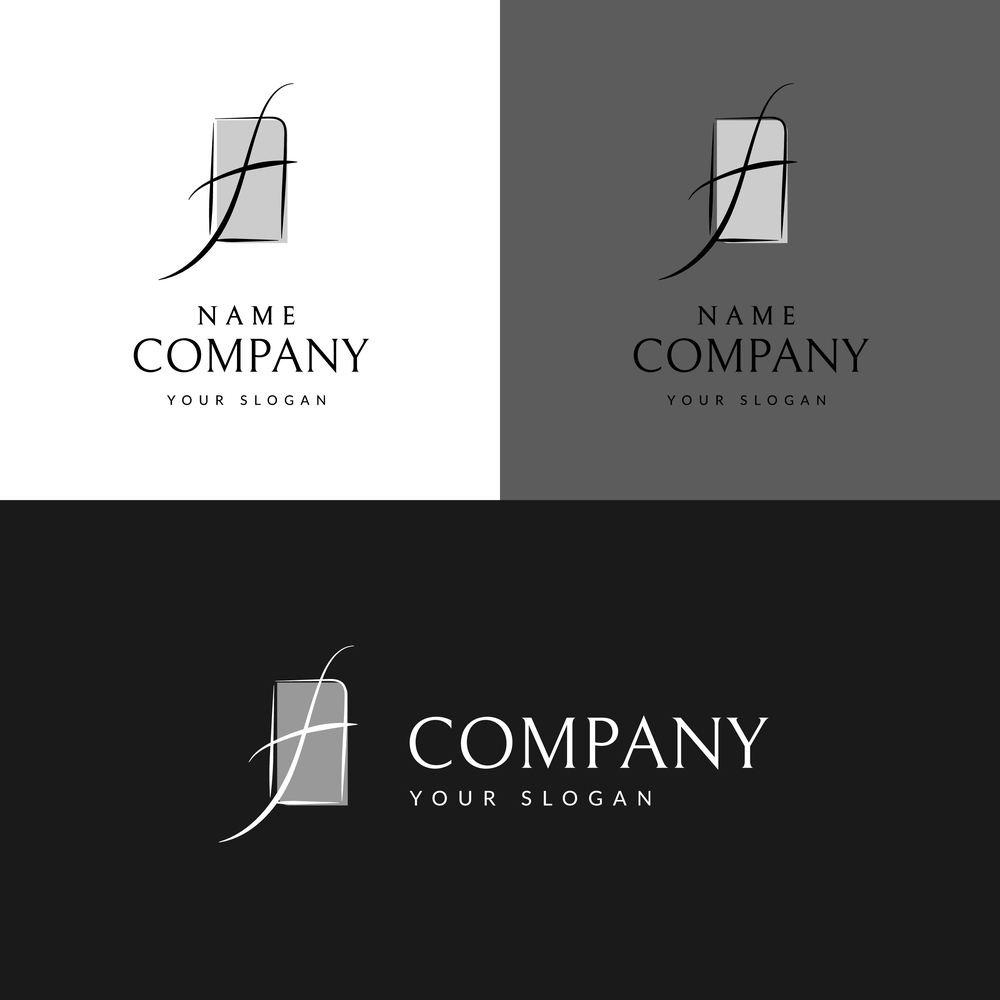
Example: If only the logo on the top left was a registered trademark, were the other logos use of the same mark?
1. Necessity to prove genuine trademark use
If you are the owner of a trademark in the European Union, either at the EUIPO or in one of the member states, you must have started genuinely using your trademark for the registered goods and services by the end of the fifth year after registration. Otherwise, your trademark becomes vulnerable to non-use cancellation actions. The same applies to every other continuous period of five years during which you have not used your trademark genuinely.
Should it become necessary to prove genuine use of your trademark, you have to show how, when, where and to which extent you have used your registered trademark over the past five years. When putting together relevant proof, it is important to first examine the available evidence as to whether or not the sign used as a trademark on the evidence is the registered trademark. Often, word marks are not used by themselves, but with additional word or figurative elements. Figurative marks are not used as registered but in slightly different colors or with the word and device parts arranged differently than registered or by omitting part of the registered mark. The variations are numerous, but the question always remains the same: Is the specific kind of use of a mark in a form differing from the one registered still considered use of the registered trademark or is the distinctive character of the mark altered significantly?
If the answer is yes, you may go on to compile further proof of genuine use of your mark. If the answer is no, you will not be able to enforce your trademark rights and you might even lose them. Considering that a registered trademark can have a great economical value and can contribute up to about 80 % (depending on your industry; the average over different industries is about 46 %) to the overall value of your company, losing your registration can be a disaster. Thus, it is VERY important to regularly check the specific uses of your trademark as to whether or not it is still use of the registered trademark.
Over the past years, case law on the question if use of a trademark in a form differing from the one registered is still considered use of the registered form has become endless and decisions are often unpredictable. Now, more reliable guidance is on the horizon!
2. New CP8 Common Practice
On 28 May 2020, the EUIPO announced that its Management Board and Budget Committee had adopted a new Common Practice (CP8) on this issue. It should bring more harmonization to how the trademark offices across the EU will handle the assessment of use of a trademark in a form differing from the one registered.
The Common Practice was adopted after about two years of discussions and consultation involving trademark offices, user associations, experts and other stakeholders. It is not binding, but the trademark offices of the EU Member States can – and most likely will – implement a corresponding procedure on a voluntary basis to increase transparency, legal certainty, consistency and predictability on use of a trademark.
The final version of the CP8 Common Practice has not yet been published, but according to the EUIPO’s press release of 28 May 2020, “it will establish general principles to assess when the use of a trademark in a form differing from the one registered alters its distinctive character. More specifically, the document assesses the impact of additions, omissions, modifications of characteristics, and combinations of these changes, on the distinctive character of registered word marks, purely figurative marks and composite marks.”
Hopefully, the Common Practice will deliver what its draft promised. Once the final version is available at the EUIPO’s homepage, check back here for the specific link.
In the meantime, if you have you any doubts whether or not use of your mark will be considered use of your registered trademark, do not hesitate to contact us by phone or email email to info@lexdellmeier.com for more information and a preliminary assessment.
As announced, LexDellmeier IP Law Firm has On Wednesday, 27 May 2020, LexDellmeier held it two webinars no. 3 and 4 "Trademark Law Basics" (in German: Markenrecht 1 x 1). We are delighted to have had 90 participants attend the webinars. Below you will find the agenda of the webinar(s) as well as the presentations (PPTs in German and English) to download as well as a link to the webinar (in German only) which was recorded and released on YouTube on 26 May 2020.
[[{"type":"media","fid":"5143","view_mode":"default","instance_fields":"override","attributes":{"height":400,"width":800},"field_file_image_alt_text[und][0][value]":"Webinar Trademark Law Basics by LexDellmeier","field_file_image_title_text[und][0][value]":"Webinar Trademark Law Basics by LexDellmeier"}]]
PowerPoint in German to download: [[{"type":"media","fid":"5139","view_mode":"default","instance_fields":"override","link_text":"20200527_final_praesentation_termin_3_webinar_3_markenrecht_1x1_de.pdf"}]]
PowerPoint in English to download: [[{"type":"media","fid":"5140","view_mode":"default","instance_fields":"override","link_text":"20200527_final_presentation_webinar_4_trademark_law_basics_en.pdf"}]]
YouTube Link to watch webinar (in German: "Markenrecht 1 x 1"): https://www.youtube.com/watch?v=xIvCkgNUsxU
Content of the Webinar "Trademark Law Basics":
I. Introduction – What is the economic value of a trademark?
II. What is a trademark from a legal point of view?
III. How can a trademark right be acquired?
IV. What benefits can be derived from a trademark?
V. LexDellmeier online trademark application
VI. Q & A
VII. Conclusion and outlook on the next webinars
Am 29. April 2020 hat die Kanzlei LexDellmeier ihr Webinar 2 zu den beiden Themenkomplexen:
1. Änderungen des deutschen Markengesetzes zum 1. Mai 2020 gemäß dem Markenmodernisierungsgesetz (MaMoG) und
2. Update BREXIT (Stand: 29. April 2020) - welche Änderungen ergeben sich für (EU-)Marken- und Designinhaber zum 1. Januar 2021
Hier können Sie sich die Folien runterladen: [[{"type":"media","fid":"5135","view_mode":"default","instance_fields":"override","link_text":"final_20200429_lexdellmeier_praesentation_termin_2_webinar_mamog_und_brexit.pdf"}]]
Wir haben das Webinar zusätzlich aufgezeichnet. Sie können es unter folgendem Link auf YouTube finden, anschauen und anhören: https://www.youtube.com/watch?v=_MwPjKlioIU&t=177s
Dear Participants of the LexDellmeier Webinar Series 2020! Here you can find all the relevant information regarding "Communication Medium & Data Protection".
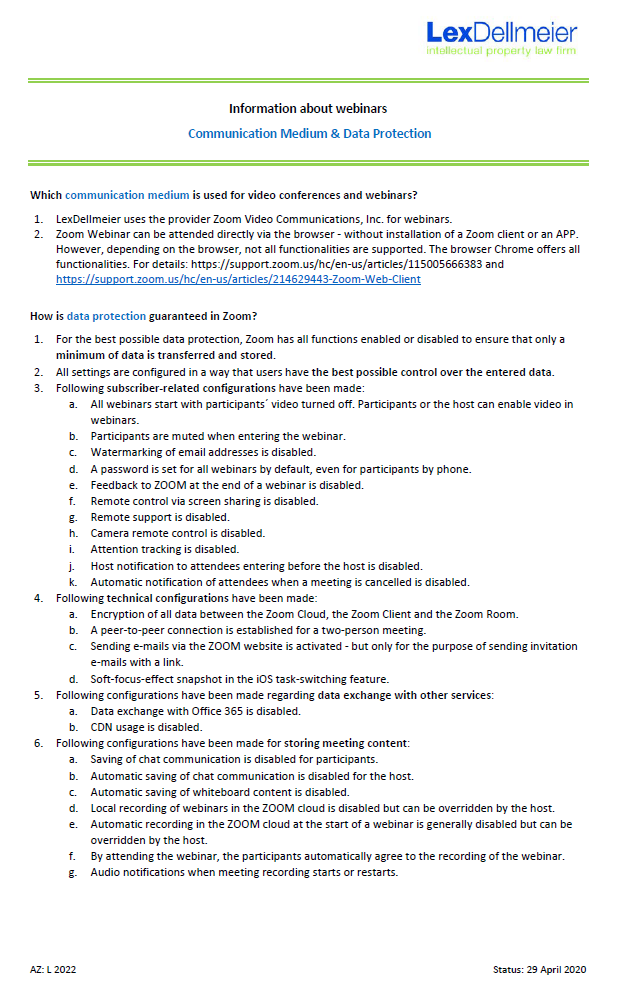
Liebe Teilnehmer der LexDellmeier Webinar Reihe 2020! Hier finden Sie alle Informationen rund um Medium und Datenschutz.
Need to get your head off Corona? Need a time-out from working on files, writing letters or answering emails? Get it where you do not expect it!
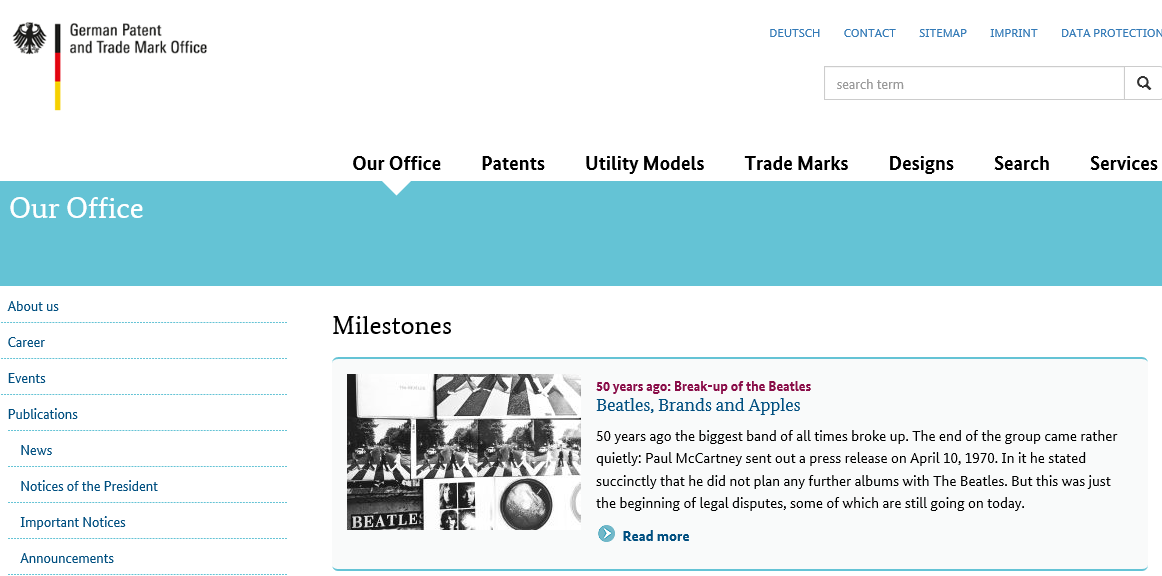
(Source: https://www.dpma.de/english/our_office/publications/milestones/index.html)
The German Patent and Trademark Office (DPMA), a source of information -- not just for plain (“boring”) facts relating to patents, trademarks and designs, but also for fun facts around IP rights. We strongly recommend taking a look that the DPMA’s homepage at www.dpma.de (English version available). Go to “Our Office”, then to “Publication” and “Milestones” and start reading… about the Beatles and what Apple Corp. has to do with Apple Inc., about Asterix and his creator Uderzo, about Mickey and Donald and other trademarks of Disney, about the Easter bunny laying eggs or about Wilhelm Conrad Röntgen who discovered X-rays.
Did you know, for instance, that
The predecessors of roller coasters were called “Russian Mountains” – artificial sliding hills with a layer of ice that had become popular in St. Petersburg in the 17th century, already, with first patents going back to the mid 1800s. (https://www.dpma.de/english/our_office/publications/milestones/rollercoaster/index.html; http://www.personal.psu.edu/users/v/a/vac3/table.html)
The Patent Office of the Netherlands refused to grant a patent, applied for in 1964, for a method of lifting sunken ships, in which foam balls were pumped into the wrecks to give them buoyancy. Reason for the denial was the lack the novelty due to a Donald Duck story published about 15 years earlier in which Donald Duck had used table tennis balls to lift a sunken yacht. (https://www.dpma.de/english/our_office/publications/milestones/donaldduckwird85/index.html)
One of the world’s oldest perfume manufacturers is “Johann Maria Farina gegenüber dem Jülichs-Platz GmbH” in Cologne which has been existing for over 310 years. The company, original inventor of “Eau de Cologne”, counts numerous famous and influential people among its customers, including Queen Victoria, Kaiser Wilhelm I., Napoleon, Mozart, Beethoven, Goethe, Oscar Wilde and even Bill Clinton. At one time, the company was so famous that even its address in Cologne “gegenüber” (opposite) Jülichs-Platz became a trademark. “Farina gegenüber” has been trademark protected in Germany since its first registration on 7 December 1929. https://www.dpma.de/english/our_office/publications/milestones/aeltesterparfuemherstellerderwelt/index.html)
Strandkorbs are a special kind of beach chairs for which the German northern coast is known. The number of all strandkorbs on the German shore is estimated at about 100,000, but its original inventor has never asked for patent protection. (https://www.dpma.de/english/our_office/publications/milestones/derstrandkorb/index.html)
The idea of “Post-it”® stickers was born because one of the developers thought it nice to have a bookmark that stayed in place without damaging the pages of the book he used during his church choir rehearsals. (https://www.dpma.de/english/our_office/publications/milestones/post-itanniversary/index.html)
Does the trademark office in your country have a website with fun facts like these? If so, please share the link with us here or by email to info@lexdellmeier.com
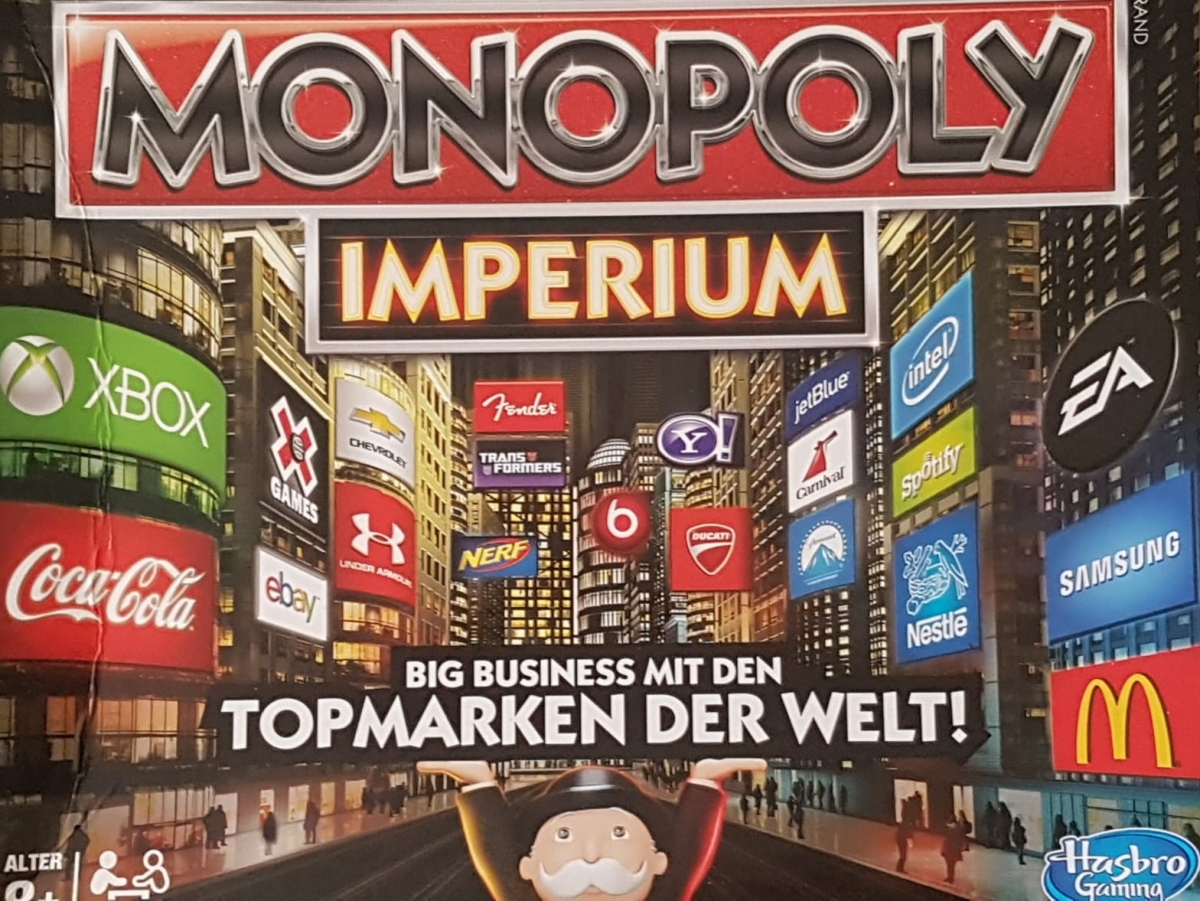
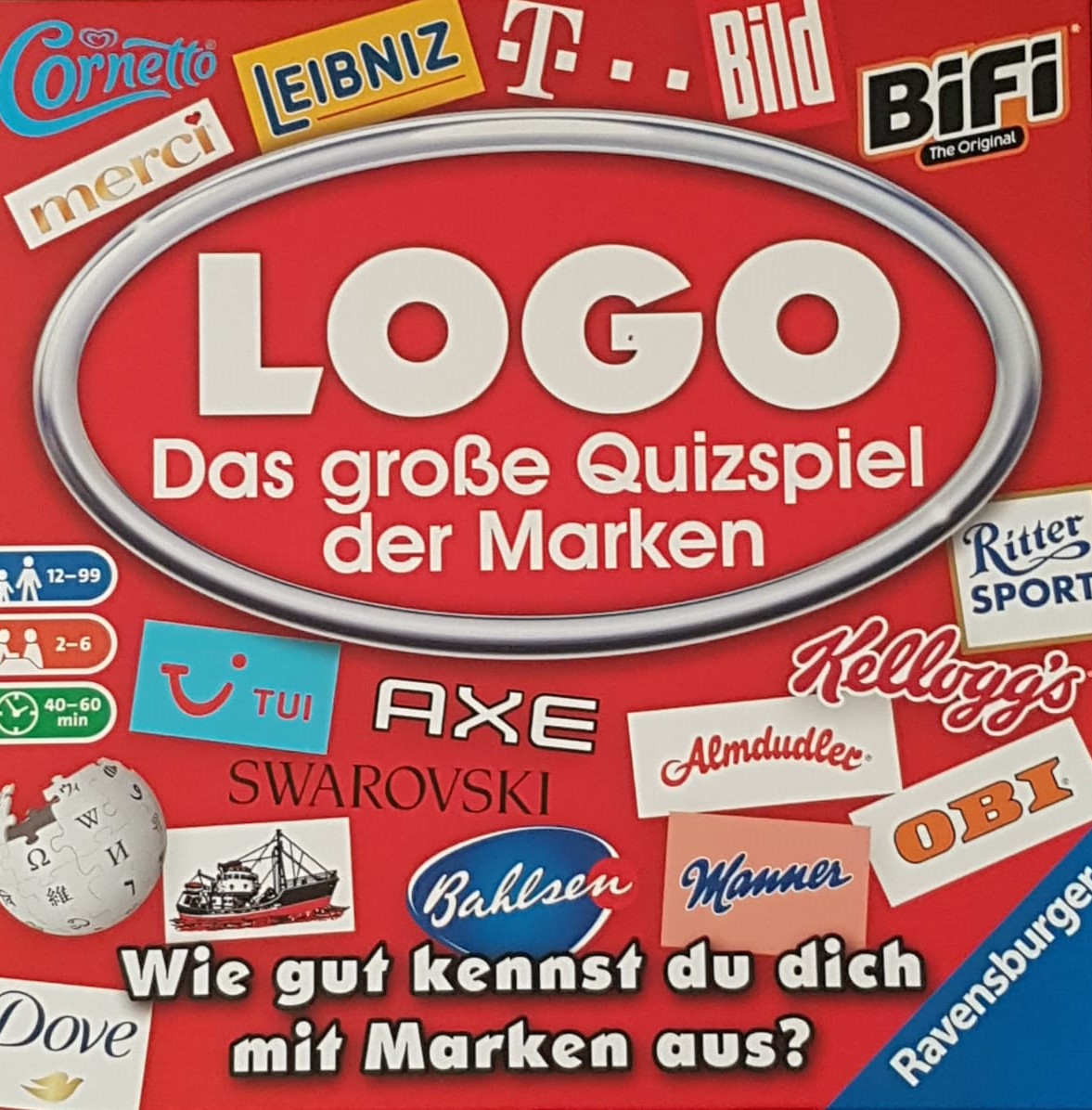
And if after reading all these fun stories you still have time and not yet enough of trademarks, how about playing a game of MONOPOLY® or LOGO?
For now, enjoy reading!