

[[{"type":"media","fid":"4840","view_mode":"default","instance_fields":"override","attributes":{"height":674,"width":720},"field_file_image_alt_text[und][0][value]":"","field_file_image_title_text[und][0][value]":""}]]
On 30 November 2017, the European General Court (EGC) upheld the previous decision of the Board of Appeal of the EUIPO in the joined cases T-101/15 and T-102/15, Red Bull v EUIPO. The EGC confirmed that the registered trademark consisting of two colors allowed several different combinations as the application did not display the requirements of precision and uniformity set out by Article 4 of Regulation No 207/2009. Now, the case continues to the next instance and so the highest court in the EU, the Court of Justice of the European Union (CJEU), will have the last word, whether the color combination will further benefit from legal protection.
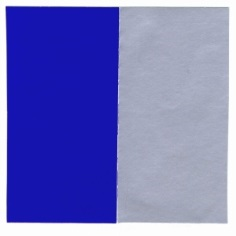
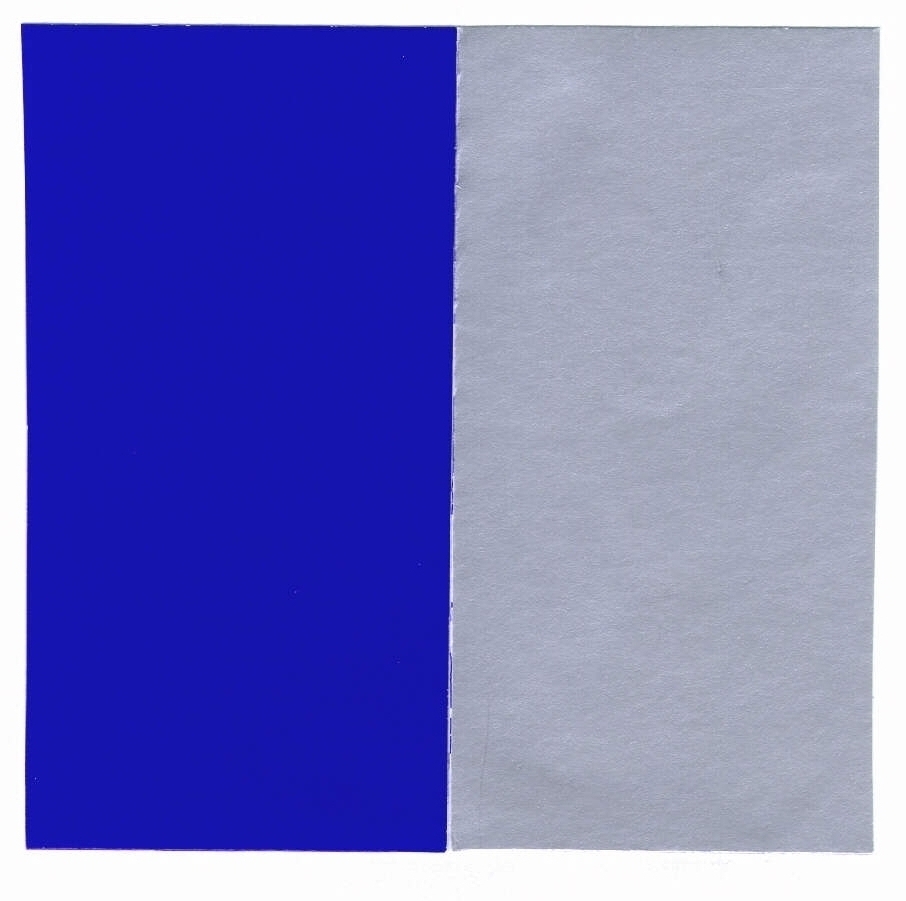
EU trademark No. 002534774 EU trademark No. 009417668
Background of the case
The Austrian company Red Bull GmbH, founded in 1987, is the market leader for energy drinks. In 2002 and 2010 the company filed for two color combinations as EU trademarks for energy drinks in class 32, No. 002534774 and No. 009417668. The first trademark was described as a combination of the colors blue (RAL 5002) and silver (RAL 9006) with ratio of the colors of approximately 50%-50%. The later one was then characterized as combination of the colors blue (Pantone 2747C) and silver (Pantone 877C). These two colors should be applied in equal proportion and juxtaposed to each other. However, in 2011 and 2013 a Polish company, Optimum Mark, filed a cancellation request against these two trademarks.
The cancellation division, and later also the Board of Appeal (BoA), decided in both cases that the trademarks do not fulfil the requirements of Article 4 of Regulation No 207/2009. The graphic representation of the depicted color combination was found lacking the qualities of precision and uniformity. In their opinion, it just constituted the mere side-by-side contrast of two colors, designated in an abstract format and without any contours.
On 30 November 2017, the EGC upheld this point of view in a joined decision. It argued that the trademarks “allowed several different combinations of the two colors and the accompanying description did not provide additional precision”. Now, the case continues further to the next instance as Red Bull filed an appeal to the CJEU.
MARQUES, the European brand owners´ association, supported Red Bull and intervened before the Court in its favour. Now, MARQUES publicly expressed its disappointment with the outcome. According to their assessment, the current decision unfairly discriminates owners of color combination trademarks by requiring an additional explicit description. In the result, the applicants will be obliged to explain how the colors will be placed on products or applied in marketing materials. This requirement is to be fulfilled even though such trademark has already once been proven to be distinctive due to extensive use. In consequence of above mentioned, the decision of the EGC might wrongly set the bar too high and make the protection of color combination trademarks effectively impossible.
On 20 November 2017 the European brand owner association (MARQUES) published a Brexit position paper where it sets out its position about the upcoming Brexit and the concerns towards the so far not drawn consequences for EU harmonised IP rights.

Source: Pixabay
Even though the Brexit day is in less than 18 months away, the governments of the UK, EU member states and the EU Commission still have not commenced any negotiations concerning this topic. Therefore, many businesses are in a constant insecurity about the future of their trademark, design and geographical indicator rights.
In order to avoid any risk of potential material threat to the interests of European IP right proprietors, the association states that the above mentioned parties should primarily agree on following three points. Firstly, no loss or diminution of protection of existing IP rights has to be guaranteed in the EU as well as in the UK. Then there should be no additional costs in order to maintain now existing rights. Finally, to prevent administrative burden on businesses when retaining their rights. The association furthermore sets a 12-point plan which includes proposals about how the EU harmonised rights should be regulated during and after Brexit. This plan covers, for instance, topics as to rights in force at the time of Brexit, creation of new rights in the UK after Brexit or how to deal with pending applications and litigation that are based on EU rights.
For a better insight on this topic, check the whole MARQUES position paper here.
As of December 2017, ROMARIN, Mardid e-Alert and Madrid Realtime Status will take the back seat as Madrid Monitor becomes WIPO´s only tool for tracking international trademark registrations.

Source: http://www.wipo.int/madrid/en/
As elaborated in our previous post of 6 June 2017, Madrid Monitor represents the next generation of ROMARIN, offering a simple and more streamlined search engine regarding international trademarks. It was built based on the user feedback and thus aims to provide exhaustive and user friendly search functions. Madrid Monitor covers all the trademarks registered through the Madrid System, and as a result, it provides a comprehensive overview and support of trademark portfolios with up-to-date information. Through Madrid Monitor, one can easily search trademarks with both pictures and key words. Among the search functions of the tool it is also possible to save and share search reports.
In order to offer an easy start with the tool as well as to ensure the effective use of all the features of Madrid Monitor, WIPO has created a free eight-part tutorial series for your information.
To receive a better insight of the topic and to learn the secrets of the tool, take a look at the WIPO´s free tutorials here.
Benoît Battistelli, the current President of the European Patent Office (EPO) will be ending his 5-year term as the EPO President in the end of May 2018. The Administrative Council of the European Patent Organisation has elected Portuguese António Campinos to fulfill his position as the EPO President.

Source to the photo.
Currently working as Executive Director of the European Union Intellectual Property Office (EUIPO), António Campinos has several years of experience in the field of intellectual property. Before his position in the EUIPO, he has been serving as the President of the Portuguese Institute of Industrial Property (INPI), representing Portugal in the Administrative Council of EPO.
European Patent Office
The European Patent Office represents the executive body and is one of the organs of the European Patent Organisation. Its main tasks include granting of the European Patents under the European Patent Convention. Furthermore, it establishes search reports for national patent applications for some Contracting States and organizes the European qualifying examination (EQE) for professional patent representatives. The EPO is headquartered in Munich and it has more than 6,500 employees from more than 34 countries.

Source to the photo.
Link to the press release of the EPO can be found here.
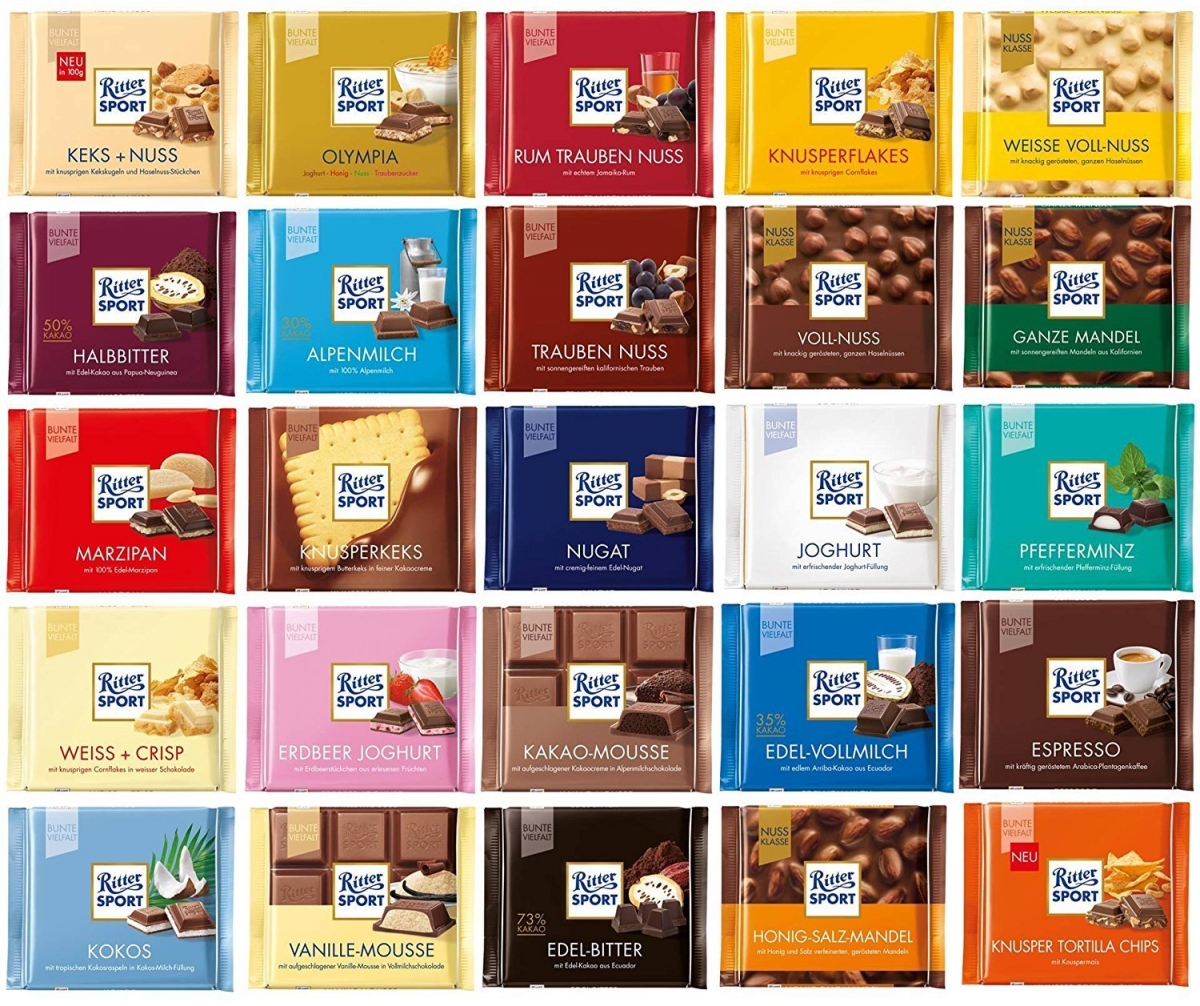
In its recent decision of 18 October 2017, the German Federal Court of Justice (Bundesgerichtshof) held square-shaped chocolate packaging eligible for protection as three-dimensional trademarks and annulled two previous rulings of the German Federal Patent Court (BPatG). Consequently, the cases are remitted back to the German Federal Patent Court.
Source to the photo.
Background of the case
For years Ritter Sport have been well-known for its colorful square-shaped chocolate bars, originally inspired by the idea of practically shaped chocolate bars fitting to the pocket of a sports jacket. In 1995 and 1998, the German Patent and Trade Mark Office (GPTO) accepted the square-formed chocolate packaging shapes as 3D trademarks in class 30, namely the German trademarks no. 39869970 and no. 2913183, depicted below.
No. 39869970 No. 2913183
Later in 2011, two declarations of invalidity against the trademarks were filed, but no grounds for invalidation were found. However, the dispute continued and appeals to the German Federal Patent Court were successful. In its decisions 2016 - 25 W (pat) 78/14 and 2016 - 25 (W) pat 79/14 on 4 November 2016, the German Federal Patent Court declared the trademarks invalid, as it found the square-shape to be exclusively due to the nature of the goods themselves, and thus falling under the Section 3(2) no. 1 of the German Trademark Act, implementing the Article 3(1)(e) of the European Union Trademarks Directive 2008/95/EC.
Nevertheless, the parties continued further to the next instance, and on 18 October 2017 the German Federal Court of Justice took an opposite standpoint and ruled in favor of the three-dimensional trademarks.
Decision
In the core of the dispute was the question whether the square-shaped form resulted from the nature of the good itself. According to the German Federal Patent Court, the Section 3(2) no 1 of the German Trademark Act has to be applied regardless of the fact that the trademarks are subject to the packaging of the product and not the product itself, as the shape of the product underneath the package was either way clearly recognizable. Furthermore, the BPatG referred to the Tripp Trapp -case (C-205/13) of the Court of Justice in The European Union (EUCJ) in its decision. According to the Tripp Trapp-case, the rationale of the grounds for refusal of registration laid down in Article 3(1)(e) of the Trademarks Directive 2008/95/EC is to prevent trademark protection from granting its proprietor a monopoly on technical solutions or functional characteristics of a product which a user is likely to seek in the products of competitors. With respect to this, the German Federal Patent Court held that the square-shape of the chocolate bar constitutes an essential characteristic, which consumers would be likely to pursue in the products of the competitors. As a practical example, the Federal Patent Court pointed out the convenience resulting from the square-shape compared to a regular rectangle-shape when putting the chocolate bar into a pocket.
The German Federal Court of Justice applied a completely different view. The Court found that the square-shape of the package did not constitute an essential functional characteristic for chocolate, following that it was unnecessary to answer the question of whether the Section 3(2) no. 1 of the German Trademark Act applied to the case. Thus, Ritter Sport´s three-dimensional packaging shape trademarks remain valid, and the cases are remitted to the BPatG.
As a result, the square-shaped chocolate bars will remain registered and thereby exclusive to Ritter Sport in Germany. The decision of the Bundesgerichtshof has not been published yet, but the German press release of the Bundesgerichshof can be found here.
On 6 September 2017 the European Commission published its position paper on issues regarding IP rights after the withdrawal date of the UK. It lays down the main principles to be taken into account in the negotiations under the Article 50 of the Treaty of Lisbon with the UK.

Source: Pixabay
There are altogether five main principles that should ensure continuity of effective IP rights in the UK as well as reduce the uncertainty of rights also after the Brexit. These five principles focus on the scope of protection, applications and exhaustion of certain rights. As geographical indications are playing a big role for the EU as forerunner on the field, also their position is to be secured also after the withdrawal date. Furthermore, the protection of databases is of special interest. The paper treats all IP rights having unitary character, the some, namely EU Trademarks, Community Designs, Community Plant Variety Rights as well as protected Geographical Indications as well protected Designations of Origin. In addition, also registered terms “traditional speciality guaranteed" and “traditional terms for wine” are assimilated to IP rights in the position paper.
I. The first general principle is that all rights having unitary character and being granted before the withdrawal date should be recognized after the withdrawal date, which secures continuity. This requires additional legislation on behalf of the UK, as there is currently no legislation regarding protection of designations of origin and geographical indications as well as traditional speciality guaranteed and traditional terms for wine. This principle seeks to ensure automatic recognition of the rights. When implementing this principle, also the effects on renewal dates, priority and seniority principles and certain specifics such as “genuine use” and “reputation rules” are of special attention. From the right holders view, administrative burden should be set to minimum and no financial costs should incur.
II. The second principle focuses on the application procedure. It guarantees that in case of on-going applications that are submitted before the withdrawal date, the applicant is entitled to the benefits arising from possible priority date in respect of pending application.
III. Applications for supplementary protection or for an extension of their duration must be granted if the application is submitted before the withdrawal date and the administrative procedure is still on-going according to the third principle.
IV. The fourth principle concerns the protection of databases. Databases are currently protected under the Directive 96/9/EC in the EU member states, and in order to seek continuity, all rights should be held in force also after the withdrawal date. In practice this means that both the EU member states as well as the UK have to adapt their legislation to prevent exclusion of protection based on nationality or establishment grounds.
V. As exhaustion is of great importance in the EU territory, it is necessary that no changes are made to the current doctrine. Thus, exhaustion of rights is the subject to the last and fifth general principle. It secures that IP rights which are exhausted before the withdrawal date will remain exhausted both in the UK and the EU territories.
For better insight on the topic, check the position paper here.
As posted earlier in our post from 10 April 2017 , the second part of changes regarding the new EU Trademark Regulation (Regulation (EU) 2015/2424) will come into force on 1 October 2017, as the changes had to be made through secondary legislation. The secondary legislation consists of the Implementing Regulation laying down detailed rules for implementing certain provisions of Council Regulation (EC) No 207/2009 on the European Union trade mark and the Delegated Regulation supplementing Council Regulation (EC) No 207/2009 on the European Union trade mark and repealing Commission Regulations (EC) No 2868/95 and (EC) No 216/96.It is now time to take a closer look to the relevant changes.
I. What are the changes?
The changes of the next phase may be divided in three categories:
1: Changes regarding the graphical representation and different types of marks,
2: The new EU Certification Marks,
3: Procedural changes.
II: Graphical representation
“What you see is what you get” will be the new underlying principle regarding trademarks from the beginning of October 2017. A sign must be represented in any appropriate form, by means of generally available technology. The requirements for the presentation are that it is clear, precise, self-contained, easily accessible, intelligible, durable as well as objective. This, in the future, should increase legal certainty and reduce objections based on formality reasons. As there are various forms for trademarks and their main function is to indicate the source of origin, this change may allow more imaginative trademarks to be registered. Furthermore, descriptions for marks will be optional. To see the most popular forms as well as required formats, please visit here.
III. EU Certification Marks
EU Certification Mark is a whole new type of mark in the EU. The EU Certification Mark is defined as mark that is
“capable of distinguishing goods or services which are certified by the proprietor of the mark in respect of material, mode of manufacture of goods or performance of services, quality, accuracy or other characteristics, with the exception of geographical origin, from goods and services which are not so certified.”
The EU Certification Mark should not be mixed up with geographical indications, although they both relate to the guarantee of a specific characteristic of a product. Thus, a Certification Mark cannot be filed in order to distinguish the goods and services in respect of geographical origin.
EU Certification Marks ensure that the goods and services comply with a given standard set out in the regulations of use and are controlled under the responsibility of the certification mark owner. The regulations of use are the core of a certification mark, and must be filed within 2 months. These include in particular, the characteristic of goods and services at hand, the conditions governing the use of the mark as well as the testing and supervision measures to be applied by the certification mark owner. For more detailed information on the new EU Certification Marks, please visit here.
IV. Procedural changes
There are several procedural changes that come into force starting 1 October 2017. The EUIPO has collected a short overview of the most significant changes. It should be emphasized that this is not an exhaustive list. The detailed information can be found under the Implementing Regulation (EU) 2017/1431, as well as the Delegated Regulation (EU) 2017/1430.
After 1 October 2017, it is no longer possible to claim priority after the application but, it must be filed already together with the application. After the application, supporting documents must be filed within three months of the filing date, instead of the previously applied three months from receipt of the declaration of priority.
In addition, there are changes concerning the acquired distinctiveness of a mark. Article 7(3) EUTMR can now be invoked at the start or later during the process, which practically reduces unnecessary expenses regarding gathering and presenting evidence.
When it comes to opposition and cancellation proceedings, the requirements of admissibility and substantiation for relative grounds’ have been reorganized in order to gain clarity. In addition, geographical indications have been taken under the Article 8(6) EUTMR. Belated evidence, as well as Office practice on suspension of surrenders and the closure/continuation of pending revocation or invalidity proceedings has been codified.
Furthermore, starting from October 2017, the EUIPO accepts evidence from online sources recognized by the office in regard to registered rights. This smoothens down the procedures, as reference can be made to an online source. What is more, not regarding certificates of filing, registration and renewal or provisions of relevant law, if the language used for evidence of substantiation is not the language of proceedings, translation is needed only if requested by the Office.
Also, a whole new process regarding trademarks has been added to the EUTMR Article 21(2)(a). The new procedure allows the proprietor of a mark to demand the assignment of the respective trademark in such case, that an agent or other representative has registered an EU Trademark without the consent of a proprietor.
As the Office has entered the internet era, the means of communication with the office will change to better utilize information technology. Hand delivery and deposit to postbox will not be available anymore, and tele copier and other technical means’ of communication – which covers faxes – has been removed from secondary legislation. However, faxes may be used as back up when specific requirements are fulfilled.
In addition, some clarifications have been made regarding the Boards of Appeal, mostly concerning the content of the statement of grounds and of the response, ‘cross appeals’, claims raised and facts or evidence filed for the first time before the Board of Appeal, new absolute grounds raised by the Board of Appeal, expedited proceedings and the organization and structure of the Boards of Appeal.
Both the EUTMIR and the EUTMDR apply from 1 October 2017, and include transitional provisions. As a main rule, both Regulations apply to ongoing proceedings from 1 October 2017 unless otherwise provided. However, as always, there are some exemptions. In order to get a better insight what are the transitional provisions regarding different situations, please see all transitional provisionals.
Geographical Indications, also known as GIs, are forms of intellectual property protection designed to protect indications associated with a location. GIs provide consumers accurate information regarding the origin of a product, as well as promote local production and enhance competitiveness. With its nearly 3,400 registered geographical indications, the European Union has been traditionally the forerunner in the field. Germany is well-known for its beers, but what else comes from Germany? In the map below is elaborated well-known GIs of Germany based on their origin.
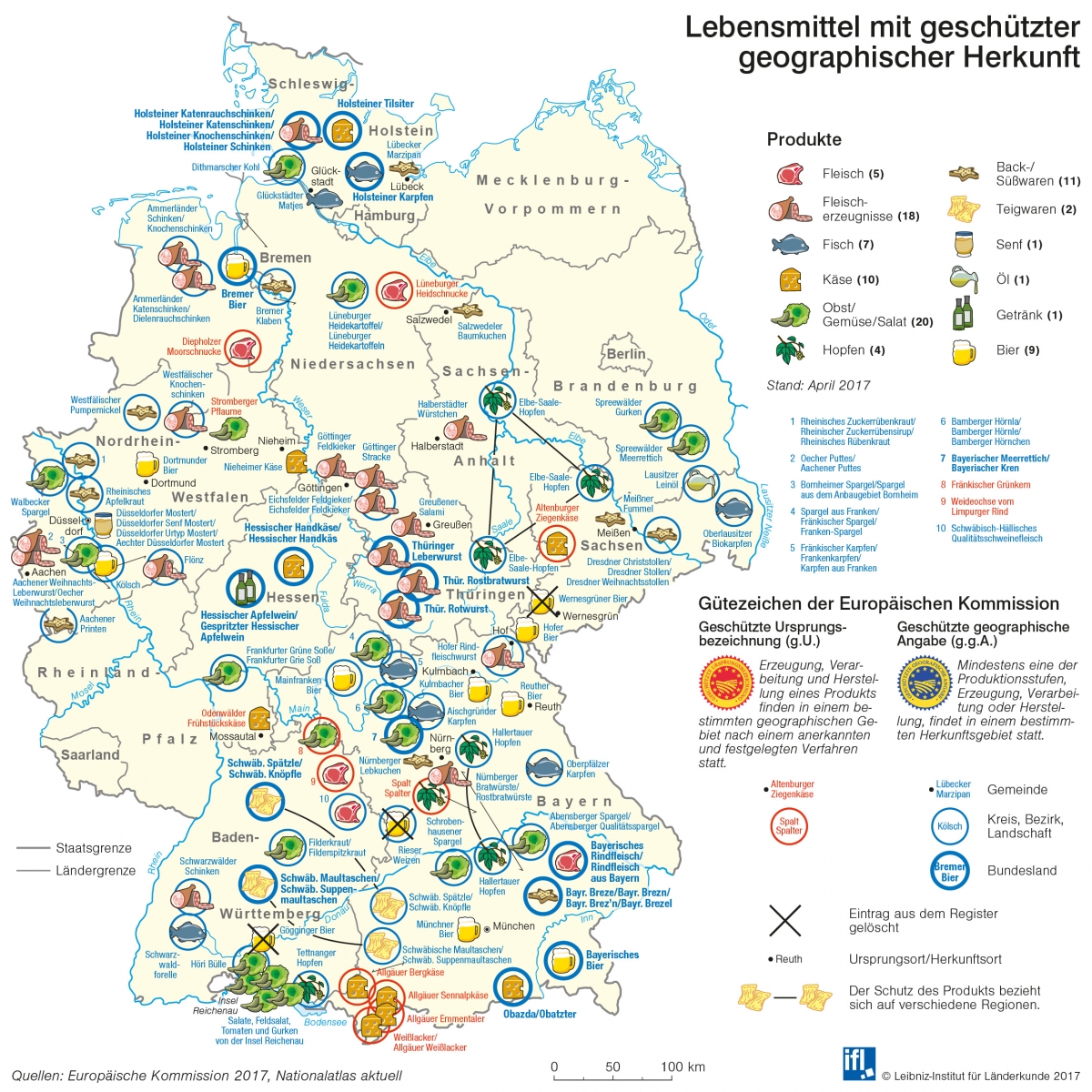
Source: Federal Ministry of Food and Agriculture website.
While going grocery shopping, we are used to buying Parma Ham, Feta and “Bayerisches beer”. When buying these products, we usually have at least subconscious expectations regarding the quality and origin of the product, and we may make assumptions that the beer comes from Bayern and that Feta is Greek, for instance. We may even take it a bit granted that certain products are of some special origin based on the name of the product without actually checking the origin. However, it should be noted that although GIs are a form of intellectual property rights, the scope of protection varies throughout the world. In this article, we give you a short overview on the situation in the EU.
On international level, the protection of GIs is a layered patchwork stemming from international treaties, such as the Agreement on Trade-Related Aspects of Intellectual Property Rights (TRIPS). In the EU, geographical indication is defined as being
“a distinctive sign used to identify a product as originating in the territory of a particular country, region or locality where its quality, reputation or other characteristic is linked to its geographical origin. (Regulation 1151/12 of the European Parliament and of the Council on quality schemes for agricultural products and foodstuffs).”
The EU regime recognizes two forms of protection, namely, protected designation of origin (PDO) and protected geographical indication (PGI), available for agricultural products and foodstuffs as well as wines. PGIs can also be used for spirit drinks and aromatized wines, but PDO protection is not available for them. In addition to these, there is a third form of protection, the traditional speciality guaranteed (TSG), which highlights the traditional production process. Although TSG´s are not considered as GIs as they do not directly link the product with a place, they should be acknowledged as they are part of EU´s quality scheme, serving similar purposes and often treated similar to GIs. It is established to safeguard traditional methods of production and recipes by helping producers of traditional product in marketing and communicating the value-adding attributes of their traditional recipes and products to consumers.

Protected Designation of Origin (PDO): Name identifying product, whose all production steps take place in the defined geographical area. In addition, the product has to owe its quality or characteristics essentially or exclusively to their place of production and the savoir-faire of local producers.
For example: Allgäuer Emmentaler g.U., Anglesey Sea Salt

Protected Geographical Indication (PGI): Name identifying a product, whose given quality, reputation or other characteristic is essentially attributable to its geographical origin and at least one of the production steps of which take place in the defined geographical area. For PGI agricultural products and foodstuffs, at least one of the stages of production, processing or preparation takes place in the area. For PGI wines, at least 85% of the grapes come from the area.
For example: Holsteiner Tilsiter, Schwäbische Spetzle, West Country Lame

Traditional Speciality Guaranteed (TSG): Mark used for products of a traditional character, which results from a mode of production, processing or composition corresponding to traditional practice for that product or foodstuff or is produced from raw materials or ingredients that are those traditionally used. For a name to be registered as a traditional speciality guaranteed, it shall have been traditionally used to refer to the specific product or identify the traditional character or specific character of the product.
For example: Mozzarella, Serrano Ham
The scope of protection for registered names is rather wide, as the names are protected against both direct and indirect commercial use, in which the products are comparable to the ones under protection. Any misuse, imitation or evocation even if the true origin is indicated by expressions such as “imitation” or “style” is prohibited in the EU, providing therefore considerably high level of protection in comparison to other regions. In 2014, the estimated value of GI infringing products in the EU was around 4.3 billion Euros, representing 9.0% of the market.
Why do we protect these indications?
GIs seek to enhance fair competition of agricultural and foodstuffs with value-adding characteristics, as well as ensure more reliable information for consumers. Furthermore, they promote innovation regarding local food production, as well as high quality of the products. Supporting local production, they create job opportunities as well as enhance rural socio-economic benefits. Although GIs has been criticized for being tools for protectionism, it should be noted that one of the main functions of GIs is to enhance fair competition and prevent misuse and counterfeiting of geographical names.
GIs are of great sales value in the European Union. According to a study conducted by the European Commission in 2011, GIs were worth €54.3 billion worldwide, and they represented 15 % of total food and drinks exports in EU.
GI Production and Consumption Shares by Country
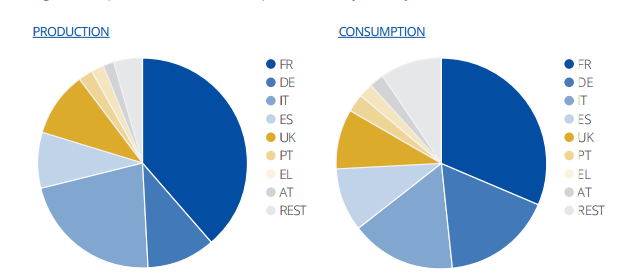
Source: EUIPO Report.
As can be seen from the table above, the top three countries regarding GIs are France, Italy and Germany. Different kinds of cheese products as well as various meat products are common for all of them. However, the production in France and Italy is more focused on fruits and vegetables, and pastries are common for Germany. Furthermore, beverages are in key roles. Beers are of special importance for Germany and wines are for France, whereas Italy on the other hand represents a mixture of products.
Although there are many registered GIs in the EU, the top 10 most popular GIs are representing 28% of the GI sales in the EU.
TOP 10 GIs in Alphabetical Order
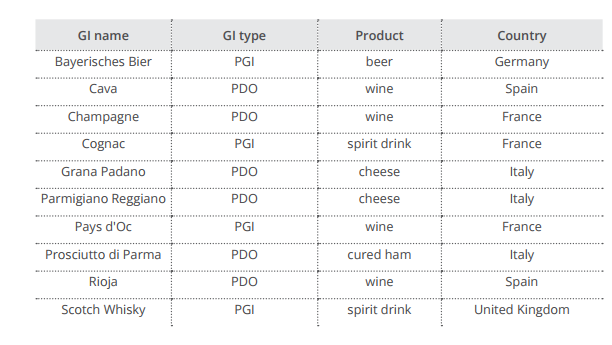
Source: EUIPO Report.
There are also other ways of protecting geographical indications. Geographical indications can thus be protected under unfair competition laws, or under EU or national collective marks as well as certification and guarantee marks. For more insight on the topic, please visit here.
This year, the German Patent and Trademark Office (DPMA) celebrates its 140th anniversary as an authority. During its long journey it has adapted to many changes and through its constant evolvement it has gained its place as number one of the national IP offices in the Europe.
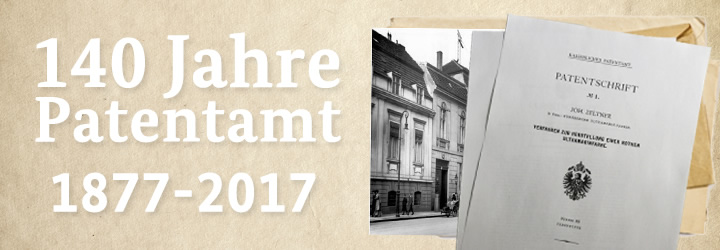
(Source:DPMA website)
The DPMA was first established in Berlin on 1 July 1877 as the Imperial Patent Office to answer the needs of booming industrialization. After the World War II, the headquarters of the federal authority was moved to Munich, were they are still located today. In 1990, the authority experienced its rapid growth phase, when 600 employees from the Office for Inventions and Patents of the German Democratic Public with more than 13 million patent documents entered the house as a result of the reunification of both German states.
With more than 850 patent examiners, some 100 trademark examiners as well as 1,550 of other staff members, the DPMA is nowadays one of the leading national centers of expertise in IP in Europe. To keep up with the future challenges, the DPMA invests in highly skilled experts as well as smooth procedures by means of high quality electronic systems. E-services constitute one of the key elements of DPMA´s success, as more than 140 patent and 300 trademark procedures are conducted electronically every working day. DPMA`s e-services enable customer friendly online application filings, IP search procedures as well as electronic transmissions.
What does it mean to be the leading European IP office in practice? In numbers, it means over 130,000 patents, trademarks, utility models and designs alone in 2016 as well as income of nearly 395 million euros the same year. Furthermore, in addition to the great number of patent and trademark applications, the DPMA handles some 600 customer enquiries and 4,400 payment transactions daily.
140 years is a great milestone for the DPMA. Counting on advanced technology solutions and great global network, the DPMA is determined to keep its place as a forerunner of IP offices in Europe.
To celebrate its anniversary, the DPMA is currently releasing each month a short insight to its long history. In order to travel in time with the DPMA, please see the publications here.