

Post Date:
Categories:
The European General Court (EGC) decided that the Community Trademark (CTM) VOODOO is not descriptive because the word “VOODOO” will just be seen as a fantasy term with a vague reference to some occult practices by the average consumer (Judgment dated 18 November 2014; Case No.: T‑50/13).
Background of the Case and Subject Matter
On 15 April 2007, the applicant filed for a CTM at the Office for Harmonization in the Internal Market (OHIM) for the word mark “VOODOO” for clothing. On 10 March 2010 the CTM was registered under the number 5832464.
Afterwards, in March 2010, the intervener, Think Schuhwerk GmbH, applied for a declaration that the contested trademark is invalid at OHIM. In its application for a declaration of invalidity the intervener alleged that the contested trademark is descriptive and lacks any distinctive character because the word mark “VOODOO” just describes a specific style of clothing or footwear which is used in the Voodoo religion. Also, the intervener based its declaration on the assumption that the applicant filed its application in bad faith.
The Cancellation Division rejected the request for declaration of invalidity. The Board of Appeal (BoA) upheld this decision in second instance. Therefore, the Think Schuhwerk GmbH appealed further to the EGC.
[[{"type":"media","fid":"4505","view_mode":"media_large","instance_fields":"override","attributes":{"class":"media-image aligncenter size-full wp-image-2076","typeof":"foaf:Image","style":"","width":"600","height":"375"}}]]
Decision of the Court
The European General Court (EGC) upheld the decision of the BoA.
First, the court pointed out, that the evidence submitted by the applicant does not show that it is reasonable to believe that the mark”VOODOO” will actually be recognized by the relevant consumer as a description for the goods.
The relevant public by reference to which the likelihood of confusion must be assessed is composed of average consumers in the EU. This average consumer may associate occult practices and black magic with Voodoo Dolls (see above) which originally come from Haiti or Africa with the word “VOODOO”. But, none of the evidence submitted by the intervener demonstrates that for these practices special clothing is needed or that the actions are bound on predefined rituals, places or events and are only for special persons. As a result of that the EGC upheld the finding of the BoA that the word “VOODOO” will be seen as a fantasy term with a vague reference to some occult practices. Therefore, the trademark is not (directly) descriptive.
The EGC also is not of the opinion that the applicant was in bad faith because he knew that the trademark was rejected at the 12 June 2007 by the German Patent and Trademark Office. The court refused this argument because a priority may be lawfully claimed from an application being the subsequent outcome of that application not registered.
Finally, the EGC is also convinced that the applicant was not in bad faith because he circumvented the obligation of use of its prior CTM „VOODOO“ for class headings. The EGC is of the opinion, that the applicant applied for the second trademark for specific goods in relation to clothing with the intention to create clearness and preciseness regarding to the scope of protection and not in a fraudulent way.
![[[{"type":"media","fid":"4505","view_mode":"media_large","instance_fields":"override","attributes":{"class":"media-image aligncenter size-full wp-image-2076","typeof":"foaf:Image","style":"","width":"600","height":"375"}}]]](/sites/default/files/2015/03/voodoo_1.jpg)
Post Date:
Categories:
The General Court of the European Union (EGC) decided that the invisible character of a product - in this case a cookie - does not relate to the appearance and therefore cannot taken into account in the examination of the requirements to fulfill for registration. An exception occurs only when the design meets the requirements of a complex product. Therefore, it has to be composed of multiple components which can be replaced permitting disassembly and re-assembly. For these reasons, this registered design for a chocolate filled cookie was invalidated (Judgment dated 9 September 2014; Case No.: T 494/12).
Background of the Case and Subject Matter
On 25 March 2009, the applicant Biscuits Poult SAS, filed an application for registration of a Community Design with the Office for Harmonization in the Internal Market (OHIM) for the following design (Community Design No 1114292-0001) for “cookies”:
[[{"type":"media","fid":"4496","view_mode":"media_large","instance_fields":"override","attributes":{"class":"media-image aligncenter size-full wp-image-2057","typeof":"foaf:Image","style":"","width":"263","height":"118"}}]]
Thereon, in February 2010, the intervener, the Banketbakkerij Merba BV applied to OHIM for a declaration that the contested design is invalid. In its application for a declaration of invalidity, the intervener alleged that the contested design is not new and has no individual character and that its appearance is just dictated by its technical function. In support of its application for a declaration of invalidity, the intervener argued, in support of its contention that the contested design is not new and lacked individual character, the earlier designs set out below:
[[{"type":"media","fid":"4497","view_mode":"media_large","instance_fields":"override","attributes":{"class":"media-image wp-image-2058 alignleft","typeof":"foaf:Image","style":"","width":"97","height":"81"}}]][[{"type":"media","fid":"4498","view_mode":"media_large","instance_fields":"override","attributes":{"class":"media-image wp-image-2059 alignleft","typeof":"foaf:Image","style":"","width":"110","height":"81"}}]][[{"type":"media","fid":"4499","view_mode":"media_large","instance_fields":"override","attributes":{"class":"media-image wp-image-2060 alignleft","typeof":"foaf:Image","style":"","width":"83","height":"80"}}]][[{"type":"media","fid":"4500","view_mode":"media_large","instance_fields":"override","attributes":{"class":"media-image wp-image-2061 alignleft","typeof":"foaf:Image","style":"","width":"155","height":"81"}}]][[{"type":"media","fid":"4501","view_mode":"media_large","instance_fields":"override","attributes":{"class":"media-image wp-image-2062 alignleft","typeof":"foaf:Image","style":"","width":"108","height":"80"}}]][[{"type":"media","fid":"4503","view_mode":"media_large","instance_fields":"override","attributes":{"class":"media-image wp-image-2064 alignleft","typeof":"foaf:Image","style":"","width":"110","height":"78"}}]] [[{"type":"media","fid":"4504","view_mode":"media_large","instance_fields":"override","attributes":{"class":"media-image wp-image-2065 alignleft","typeof":"foaf:Image","style":"","width":"105","height":"78"}}]][[{"type":"media","fid":"4502","view_mode":"media_large","instance_fields":"override","attributes":{"class":"media-image wp-image-2063 alignleft","typeof":"foaf:Image","style":"","width":"137","height":"78"}}]]
By decision of 28 February 2011, the Cancellation Division of OHIM dismissed the application for a declaration that the contested design was invalid. Therefore, the intervener lodged an appeal at OHIM against the decision of the Cancellation Division on 22 April 2011.
By decision of 2 August 2012, the Third Board of Appeal (BoA) of OHIM declared the contested design invalid because the BoA is of the opinion that the disputable design has no individual character. The BoA pointed out that the layer of filling inside the cookie could not be taken into consideration for the assessment of the individual character of the contested design, as it does not remain visible during normal course of use of the product. Furthermore, the BoA considered that the outer appearance of the contested design was the same as the first three earlier designs (see above). Finally, the BoA found that the contested design does not produce on an informed user who regularly consumes that type of cookie a different overall impression from that produced by the three earlier designs, given the broad margin of freedom the designer of this type of product has.
Therefore, the applicant - Biscuits Poult SAS - appealed further to the EGC.
Decision of the Court
The EGC dismissed the action and endorsed the BoA’s findings.
The court argued that the BoA did not err in stating that the invisible character of the product does not relate to the appearance and cannot take into account in the examination of the requirements to fulfil for register a design.
Furthermore, a cookie such as the one portrayed in the contested design is not a complex product because it is not composed of multiple components which can be replaced permitting disassembly and re-assembly.
Finally, the EGC figured out that the irregular, rough surface on the outside of the cookie, its golden color, round shape and the presence of chocolate chips are characteristics which are common to the conflicting designs and decisive for the overall impression produced on an informed user, so that the contested design cannot be regarded as having individual character.
![[[{"type":"media","fid":"4496","view_mode":"media_large","instance_fields":"override","attributes":{"class":"media-image aligncenter size-full wp-image-2057","typeof":"foaf:Image","style":"","width":"263","height":"118"}}]]](/sites/default/files/2015/03/cookie-1_1.png)
![[[{"type":"media","fid":"4497","view_mode":"media_large","instance_fields":"override","attributes":{"class":"media-image wp-image-2058 alignleft","typeof":"foaf:Image","style":"","width":"97","height":"81"}}]][[{"type":"media","fid":"4498","view_mode":"media_large","instance_fields":"override","attributes":{"class":"media-image wp-image-2059 alignleft","typeof":"foaf:Image","style":"","width":"110","height":"81"}}]]](/sites/default/files/2015/03/cookie-2_1.png)
![[[{"type":"media","fid":"4503","view_mode":"media_large","instance_fields":"override","attributes":{"class":"media-image wp-image-2064 alignleft","typeof":"foaf:Image","style":"","width":"110","height":"78"}}]]](/sites/default/files/2015/03/cookie-9_1.png)
Post Date:
Categories:
The General Court of the European Union (EGC) decided that that a likelihood of confusion between the word/device mark “Master” of Modern Industrial & Trading Investment Co. Ltd and the earlier trademark “Coca Cola” of the Coca - Cola Company cannot be excluded (Judgment dated 11 December 2014; Case No.: T‑480/12).
Background of the Case and Subject Matter
On 10 May 2010, the intervener - Modern Industrial & Trading Investment Co. Ltd (“Mitico”) - filed an application for registration of a Community trademark at the Office for Harmonisation in the Internal Market (OHIM) for the following word/device mark for – among others – nonalcoholic beverages:
[[{"type":"media","fid":"4492","view_mode":"media_large","instance_fields":"override","attributes":{"class":"media-image aligncenter size-full wp-image-2042","typeof":"foaf:Image","style":"","width":"240","height":"198"}}]]
Thereon, in October 2010 the American multinational beverage corporation and manufacturer, retailer and marketer of nonalcoholic beverage concentrates and syrups “The Coca-Cola Company” filed an opposition based on four earlier Coca-Cola Community word/device trademarks reproduced below:
[[{"type":"media","fid":"4493","view_mode":"media_large","instance_fields":"override","attributes":{"class":"media-image aligncenter size-full wp-image-2043","typeof":"foaf:Image","style":"","width":"502","height":"199"}}]]
And it was also based on the earlier United Kingdom figurative mark “C”, reproduced below:
[[{"type":"media","fid":"4494","view_mode":"media_large","instance_fields":"override","attributes":{"class":"media-image aligncenter size-full wp-image-2044","typeof":"foaf:Image","style":"","width":"464","height":"120"}}]]
The Coca - Cola Company filed an opposition on the basis that the trademark “Master” is confusingly similar to Coca - Cola’s earlier registrations and on the basis of the high reputation of its earlier trademarks. Coca - Cola is of the opinion that a likelihood of confusion between the two trademarks exists because both trademarks are written in the “Spenserian script”; also the letter “a” of the trademarks is similar and both use a “tail” for the first letter. Therefore, the trademark “Master” is particularly similar from a visual perspective, although it conceded that the trademarks were dissimilar phonetically and conceptually.
Decision of the Board of Appeal of OHIM
OHIM originally dismissed the opposition and Coca-Cola appealed to the Board of Appeal (BoA) who also rejected the action determining that there is no similarity between the trademarks and so there could be no likelihood of confusion and also no link could be established between the trademarks.
The BoA argued that, although Coca-Cola is the proprietor of a range of highly famous and well-known Coca-Cola trademarks whose reputation was connected to their depiction in “Spenserian script”, that did not mean that it was the proprietor of that - undeniably elegant - script, which was freely available to be used by everybody.
Furthermore, although the goods are identical and the earlier trademarks have an undeniable reputation, it is difficult to understand why a consumer would confuse the word “Master”, combined with an Arabic word with the earlier trademarks containing the word “Coca-Cola”, when no overlap textually.
Therefore, OHIM and the BoA came to the result that there is nothing tangible in the earlier signs which was reproduced in the sign applied for, apart from the ‘tail’ element of each sign, flowing from the base of the letters “C” and “M” respectively.
Finally, the BoA dismissed Coca-Cola’s assertion that, in practice and on the market, Mitico was supplying products bearing labels mimicking those to be found on Coca-Cola’s products, on the ground that the relevant question in the case before it was whether the trademark as applied for was confusingly similar to the earlier trademarks as registered, and the way in which the trademarks might be used in practice was irrelevant for the purposes of that assessment.
Therefore, the Coca-Cola Company appealed further to the General Court of the European Union (EGC).
Decision of the Court
The EGC reassessed the similarity of the trademarks and concluded that the BoA was wrong to hold that there was no degree of similarity between the marks.
During the opposition proceedings, Coca - Cola had provided evidence relating to Mitico’s commercial use of the mark in respect of which registration was sought. That evidence included a witness statement by L. Ritchie, Coca-Cola’s lawyer, dated 23 February 2011, to which she appended screen shots of Mitico’s website, www.mastercola.com, printed on 16 February 2011. Those screen shots were intended to show that Mitico was using the trademark applied for in the course of trade in the form shown below:
[[{"type":"media","fid":"4495","view_mode":"media_large","instance_fields":"override","attributes":{"class":"media-image aligncenter size-full wp-image-2045","typeof":"foaf:Image","style":"","width":"494","height":"192"}}]]
The BoA stated that if, on the basis of that evidence, it were proved to be true that Mitico had deliberately adopted the same get-up, imagery, stylization, font and packaging as the Coca-Cola Company, then the latter could reasonably argue that Mitico intended to illegitimately take advantage of the repute of the earlier trademarks. But, these circumstances cannot be taken into account in the decision, if there is no similarity at all between the trademarks of Coca Cola to the trademark “Master”.
The EGC pointed out, that if there is some similarity, however faint, between the conflicting trademarks, a global assessment must be carried out in order to ascertain whether, notwithstanding the low degree of similarity between the signs, there is, on account of the presence of other relevant factors such as the reputation of recognition of the earlier trademark, a likelihood of confusion or a link made between the trademarks and the relevant public.
Therefore, the EGC came to the conclusion that there is a low degree of similarity because both trademarks are written in the “Spenserian script” and both use a “tail” for the first letter. The BoA failed to carry out a global assessment taking into account that both trademarks are written in Spenserian script, and accordingly failed to regognize that element of visual similarity between the signs at issue.
But, in this specific case even only a low degree of visual similarity is sufficient as the products behind the trademarks are sold in self services stores. Consumers in such stores are guided more by the overall visual impression. As a result, the figurative element is even more important than the word itself. However faint the degree of similarity between the signs is, the relevant public might establish a link between the trademarks at issue.
Therefore, the BoA is allowed to take into consideration all circumstances - the get-up, imagery, stylization, font and packaging - in their decision. The EGC held that the above assessment by the BoA departed from the existing case-law, pursuant to which, in essence, a finding of a risk of free-riding may be established, in particular, on the basis of logical deductions resulting from an analysis of the probabilities and by taking account of the usual practices in the relevant commercial sector as well as all the other circumstances of the case, including the use, by the proprietor of the mark applied for, of packaging similar to that of the goods of the proprietor of the earlier trademarks.
As it is, the evidence relating to the commercial use of the trademark applied for, as produced by Coca-Cola during the opposition proceedings, manifestly constitutes relevant evidence for the purposes of establishing such a risk of free-riding in the present case.
On the above basis, the EGC concluded that there is a risk that the public might establish a link between MITICO’s goods and those of Coca-Cola and that the BoA was wrong to conclude otherwise.
For these reasons, the EGC annulled the contested decision and asked the BoA to re-examine the case on the basis of the EGC’s findings. We are looking forward to the BoA’s decision within the next months.
![[[{"type":"media","fid":"4492","view_mode":"media_large","instance_fields":"override","attributes":{"class":"media-image aligncenter size-full wp-image-2042","typeof":"foaf:Image","style":"","width":"240","height":"198"}}]]](/sites/default/files/2015/02/cola-1_1.png)
![[[{"type":"media","fid":"4493","view_mode":"media_large","instance_fields":"override","attributes":{"class":"media-image aligncenter size-full wp-image-2043","typeof":"foaf:Image","style":"","width":"502","height":"199"}}]]](/sites/default/files/2015/02/cola-2_1.png)
Post Date:
Categories:
The Office for Harmonization in the Internal Market (OHIM), the responsible office in the EU for registering Community Trademarks and Community Designs having the "automatic" effect throughtout 28 national EU Member States, just published a unique map which gives a quick overview on Intellectual Property (here: Trademarks, Designs, Patents and Copyrights).
[[{"type":"media","fid":"4491","view_mode":"media_large","instance_fields":"override","attributes":{"class":"media-image aligncenter size-full wp-image-2035","typeof":"foaf:Image","style":"","width":"660","height":"303"}}]]
Post Date:
Categories:
The EGC (European General Court) decided that in the context of a computerized booking system, the final price to be paid must be indicated whenever the prices of air services are shown (Judgment dated 15 January 2015; C 573/13).
Introduction
The European Regulation No 1008/2008 is worded as follows:
„Customers should be able to compare effectively the prices for air services of different airlines. Therefore the final price to be paid by the customer for air services originating in the Community should be indicated every time, inclusive of all taxes, charges and fees. Community air carriers are also encouraged to indicate the final price for their air services from third countries to the Community.”
[[{"type":"media","fid":"4490","view_mode":"media_large","instance_fields":"override","attributes":{"class":"media-image aligncenter wp-image-2030","typeof":"foaf:Image","style":"","width":"870","height":"348"}}]]
Background of the Case and Subject Matter
Until the end of 2008, Air Berlin’s booking system was organized in such a way that, having selected a journey and a date, the customer would find, as a second step, a table listing the possible flight connections for the chosen date, and showing departure and arrival times and two fares for each flight. A box below that table showed the taxes and charges applicable to the air service selected and the fuel surcharge, while the „price per person“ including all those elements was set within a border. A double asterisk next to the box explained, with reference to the conditions applicable, that a service charge not yet included in the final price might apply. After entering the necessary personal details as a third step, the customer could, in the fourth step, establish the final price of travel, including the service charge.
As a result of the entry into force of a new European Regulation (No 1008/2008) on 1 November 2008 (see above), Air Berlin modified the second step of its booking system so that the air fare for the selected air service was displayed in the table together with the departure and arrival times and, separately, taxes and charges, the fuel surcharge and the total amount of those separately indicated elements. A box below the table showed the price calculated on the basis of those figures, the service charge and, below that, the final price per person for the selected flight.
An association for customer protection took the view that even this new presentation of prices is not compatible with the European Regulation. Therefore, it brought an action against Air Berlin by which it sought an order requiring Air Berlin to discontinue this practice and reimbursement of the costs incurred in connection with a warning notice relating to that action. The application of the association having been granted by the court of first instance, whose judgment was upheld on appeal, Air Berlin brought an appeal on a point of law before the German Federal Court. The German Federal Court was not sure how to interpret the Regulation No 1008/2008 and asked the EGC for a preliminary ruling.
Preliminary ruling
The EGC decided that the Regulation No 1008/2008 must be interpreted that in the context of a computerized booking system, the final price to be paid must be indicated whenever the prices of air services are shown, including when they are shown for the first time. Furthermore, the final price to be paid must be indicated not only for the air service specifically selected by the customer, but also for each air service in respect of which the fare is shown. A final ruling on the case still needs to be taken by the German Federal Court.
![[[{"type":"media","fid":"4490","view_mode":"media_large","instance_fields":"override","attributes":{"class":"media-image aligncenter wp-image-2030","typeof":"foaf:Image","style":"","width":"870","height":"348"}}]]](/sites/default/files/2015/02/flugzeug_1.jpg)
Post Date:
Categories:
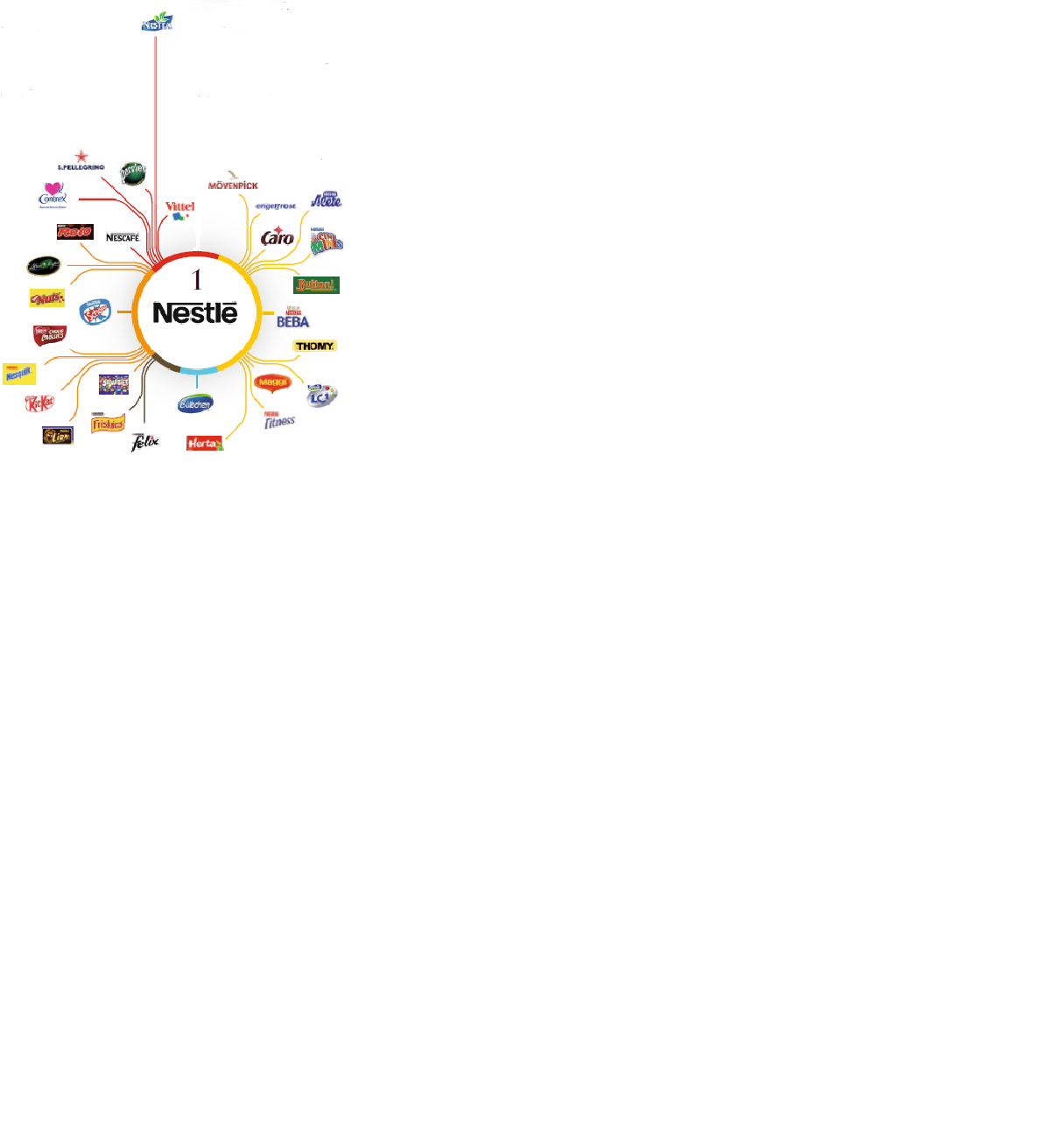
The world is filled with milion of brands but, behind most of them are only a few big cooperations. These companies control the gobal consumers markets for food, beverages, cleaning preperations, personal care products, cosmetics and cigarettes. They control the production of industrial sugar, fat and other ingredients which are essential for all other favourite cosumegoods.
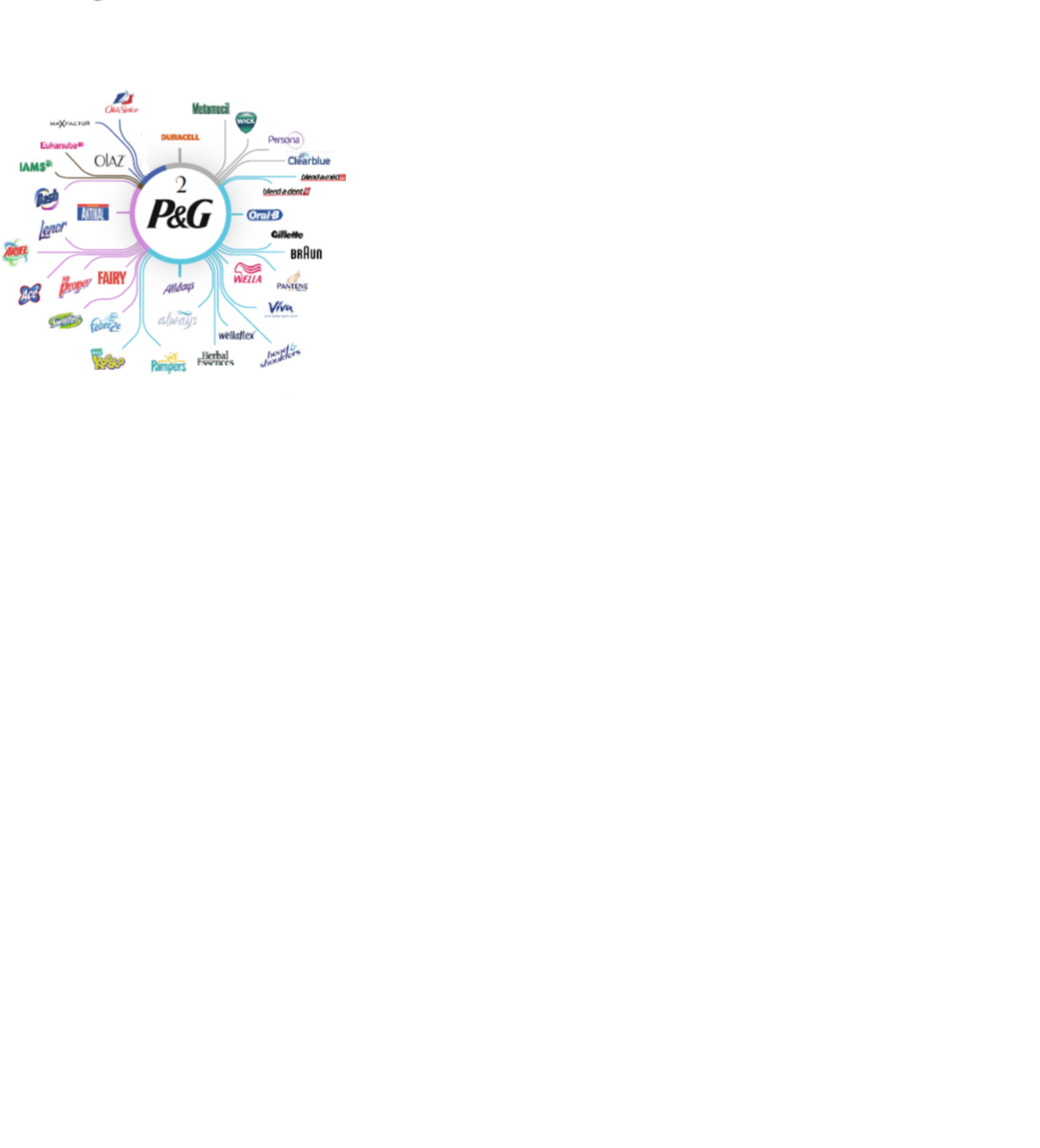
The German Newpaper „Die Zeit“ illustrated the big brands on sale and their revenues in Germany.
Nestle S.A.: The largest food manufacture in the world is also the biggest Swiss company based in Vevey and Cham. Through many acquisitions Nestlé received more than 8.000 brands (the most important ones you can see on the picture below). Their products cover a number of different markets, including coffee, bottled water, milkshakes and other beverages, breakfast cereals, infant foods, performance and healthcare nutrition, seasonings, soups and sauces, frozen and refrigerated foods, and pet food. Their rvenue in 2013 was approx 104.414 billion US Dollars.
[[{"type":"media","fid":"4487","view_mode":"media_large","instance_fields":"override","attributes":{"class":"media-image aligncenter wp-image-2024","typeof":"foaf:Image","style":"","width":"413","height":"447"}}]]
Procter & Gamble: Procter & Gamble Co. (P&G) is an American multinational consumer goods company headquartered in downtown Cincinnati, Ohio, United States. Its products include pet foods, cleaning agents and personal care products. In August 2014, P&G announced it was streamlining the company, dropping around 100 brands and concentrating on the remaining 80 brands, which are producing 95 percent of the company's profits. Their revenue in 2013 was approx 84.17 billion US Dollars.
[[{"type":"media","fid":"4488","view_mode":"media_large","instance_fields":"override","attributes":{"class":"media-image aligncenter size-full wp-image-2025","typeof":"foaf:Image","style":"","width":"450","height":"371"}}]]
Unilever: Unilever is an Anglo–Dutch multinational consumer goods company co-headquartered in Rotterdam (Netherlands) and London (Great Britain). Its products include food, beverages, cleaning agents and personal care products. Their revenue in 2013 was approx 55.795 billion US Dollars.
[[{"type":"media","fid":"4489","view_mode":"media_large","instance_fields":"override","attributes":{"class":"media-image aligncenter size-full wp-image-2026","typeof":"foaf:Image","style":"","width":"293","height":"337"}}]]
To find all Brand Octopuses please follow the link: http://images.zeit.de/wissen/2013-05/s39-infografik-marken.pdf
![[[{"type":"media","fid":"4487","view_mode":"media_large","instance_fields":"override","attributes":{"class":"media-image aligncenter wp-image-2024","typeof":"foaf:Image","style":"","width":"413","height":"447"}}]]](/sites/default/files/2015/02/octopuses-11_1.png)
![[[{"type":"media","fid":"4488","view_mode":"media_large","instance_fields":"override","attributes":{"class":"media-image aligncenter size-full wp-image-2025","typeof":"foaf:Image","style":"","width":"450","height":"371"}}]]](/sites/default/files/2015/02/octopuses-21_1.png)
Post Date:
Categories:
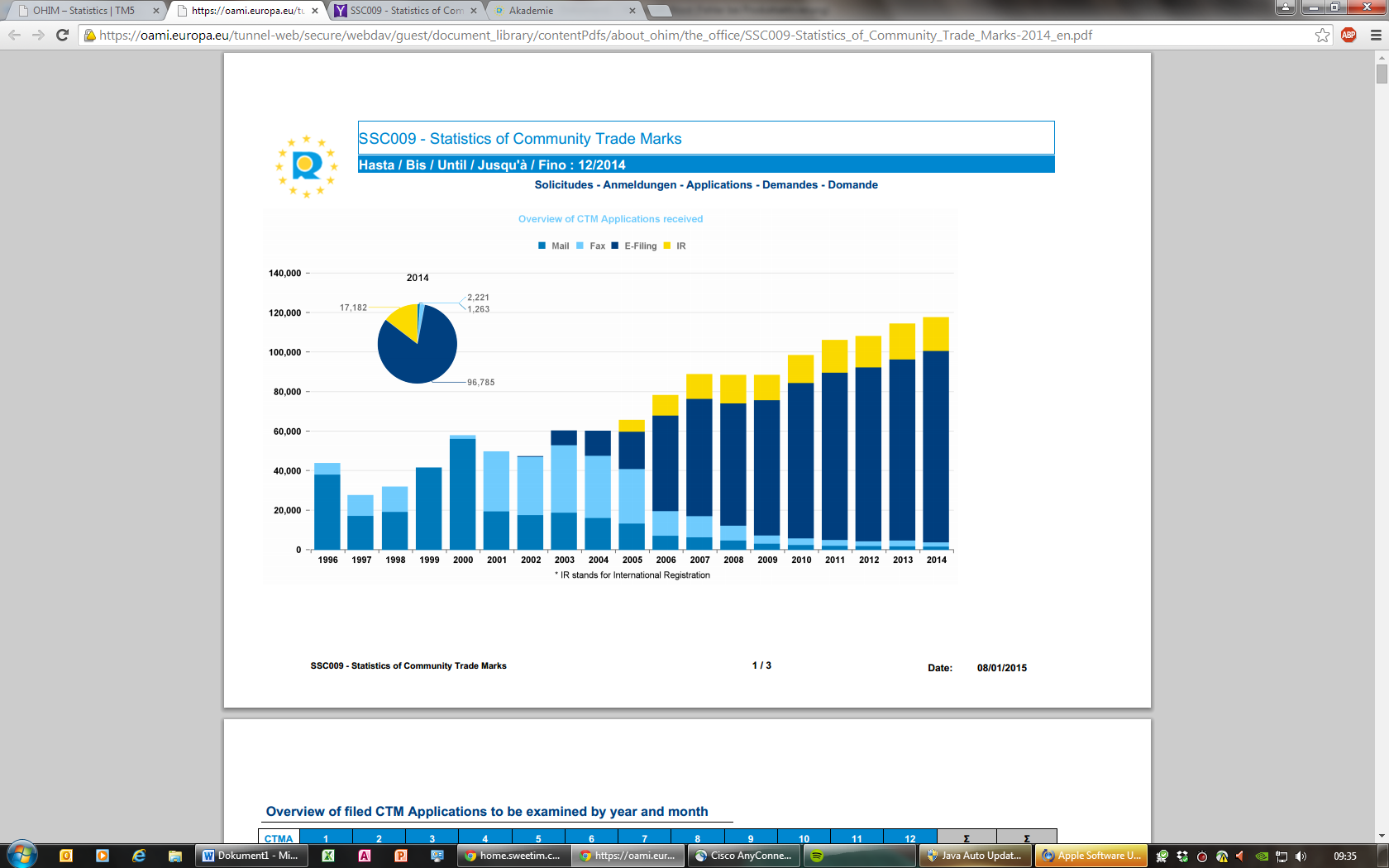
The „TM5“ just published a Statistics about the development of Community Trademarks in 2014.
Below you can see that 117.451 Community Trademark (CTM) Applications were received by OHIM in 2014. As you can see, the E-Filling is meanwhile the most popular application form since its introduction in 2005.
[[{"type":"media","fid":"4482","view_mode":"media_large","instance_fields":"override","attributes":{"class":"media-image aligncenter size-full wp-image-2016","typeof":"foaf:Image","style":"","width":"600","height":"291"}}]]
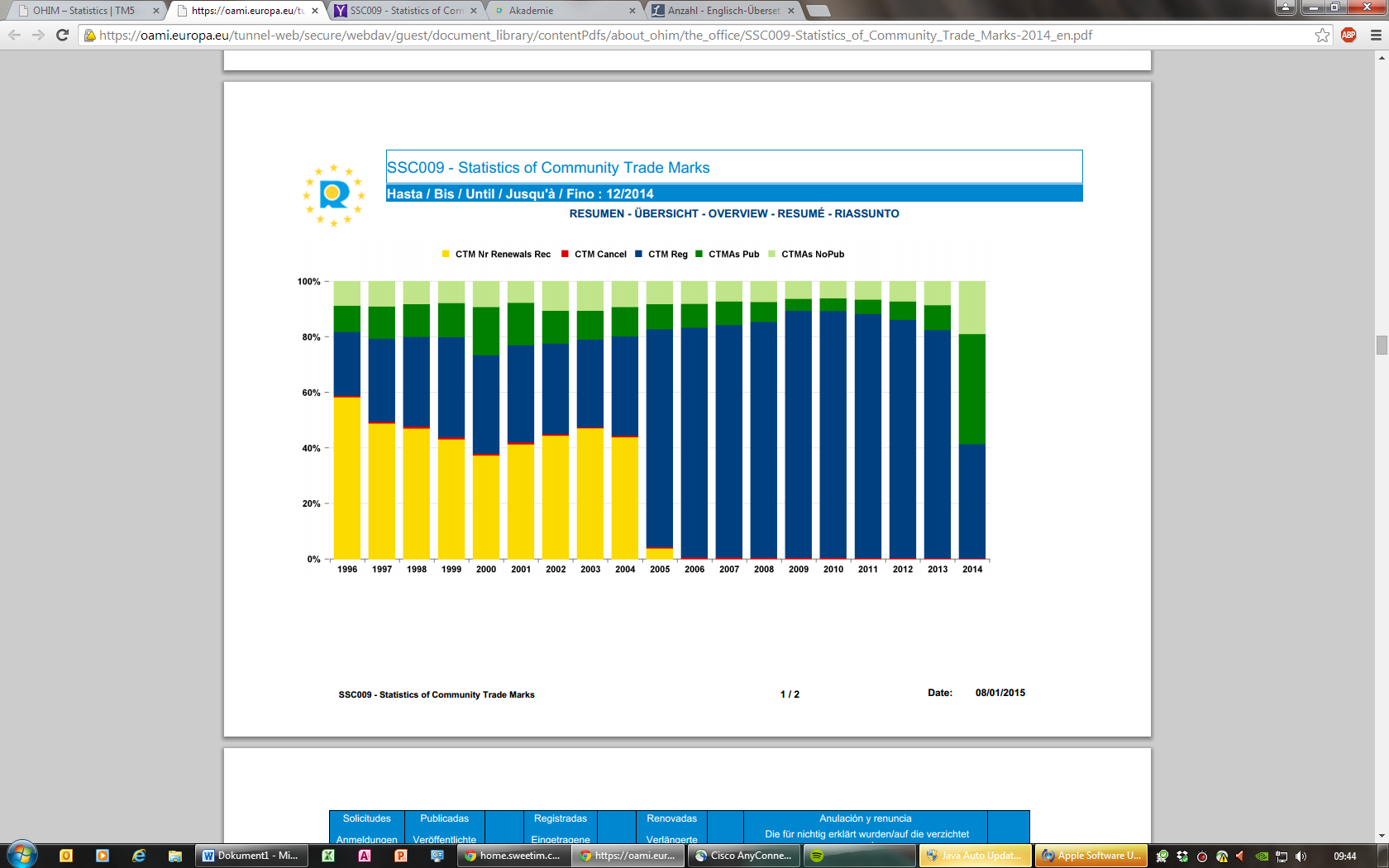
After examination, if the application is accepted it will go for publication. In 2014, 109.464 applications were published. Within the time of three month after publication a notice of opposition may be filled. This possibility was used 15,737 times last year. 103.782 trademarks were registered in 2014 after the period of publication because no opposition was filed or the opposition was not successful. After registration, a CTM can only get removed via a nullity cancelation procedure. 613 CTMs were cancelled and surrendered in 2014. If the CTM is not cancelled it is valid for ten years. After that time it has to be renewed. In 2014, 28.190 CMT renewal were reveived at OHIM.
[[{"type":"media","fid":"4483","view_mode":"media_large","instance_fields":"override","attributes":{"class":"media-image aligncenter size-full wp-image-2017","typeof":"foaf:Image","style":"","width":"600","height":"291"}}]]
For more detailed information and other statistics please see:
https://oami.europa.eu/tunnel-web/secure/webdav/guest/document_library/contentPdfs/about_ohim/the_office/SSC009-Statistics_of_Community_Trade_Marks-2014_en.pdf
![[[{"type":"media","fid":"4482","view_mode":"media_large","instance_fields":"override","attributes":{"class":"media-image aligncenter size-full wp-image-2016","typeof":"foaf:Image","style":"","width":"600","height":"291"}}]]](/sites/default/files/2015/02/tm5-11_1.png)
Post Date:
Categories:
[[{"type":"media","fid":"4474","view_mode":"media_large","instance_fields":"override","attributes":{"class":"media-image aligncenter size-full wp-image-1991","typeof":"foaf:Image","style":"","width":"194","height":"55"}}]]
What is VoteBash?
VoteBash is a worldwide, online social voting site which was just launched recently. The idea is simple. VoteBash gives people the freedom to speak out their mind and to find out what other people think about inspiring and up-to-date topics. VoteBash is great for brands and organizations who want to simultaneously distribute their brand or cause and get important insights from their audience. Everybody is entitled to an opinion – and sign-up is for free. Therefore, join VoteBash and become a “voter” and “citizen”!
[[{"type":"media","fid":"4473","view_mode":"media_large","instance_fields":"override","attributes":{"class":"media-image aligncenter wp-image-1990","typeof":"foaf:Image","style":"","width":"224","height":"222"}}]]
Who is the creator of VoteBash?
VoteBash is a privately-held company and is founded in Wilmington, Delaware, USA. The company is headquartered in Raleigh, NC, USA (Research Triangle Area). The CEO and Founder, Martijn Atell, has worked and lived in the Netherlands, Germany and the United States. He holds a BSc in Electrical Engineering with honors and a BSc in Information Communication Technology both from Rotterdam University of Applied Sciences.
He has over ten years of experience at a Fortune Global 500 automotive company. With VoteBash he is carrying out the mission to surface the opinions of others and make them more accessible in a universal way and combines individuality, connectivity, unity and fun.
What does the new VoteBash Brand stand for?
The concept behind the new VoteBash logo is simple. Starting from the idea of a social network, the graphic part shows a typical social symbol (the comic balloon) with the initials “V” and “B” in it. At the same time, the letter “B” symbols a heart. This symbol refers to the preferences, the opinions and the passions of the voters which are the most important part of our community.
[[{"type":"media","fid":"4475","view_mode":"media_large","instance_fields":"override","attributes":{"class":"media-image aligncenter wp-image-1992","typeof":"foaf:Image","style":"","width":"246","height":"184"}}]]
How does VoteBash work?
VoteBash offers you the possibility to share a “Voteled” to find out the opinion of other users (citizens). A “Voteled” is a one-question-poll which can be enriched with imagery or a custom button for people to earn and a backlink to a website or resource of your choosing. This is a perfect opportunity for brands and organizations to expose logos, product imagery and to drive free traffic to their business or cause. VoteBash is currently available in many different languages and in approx. 30 countries.
When you have created your “Voteled”, people can vote on it for eight weeks. After that, the voting will be closed, but the “Voteled” will still be visible with the end result. As an example we have inserted a screenshot of the Voteled Billboard below. You can see the different topics like Entertainment, Sports, Lifestyle Travel, Product & Consumer etc. If you are interested in one of the sectors you can click them, to see some more questions which fit to the topic.
[[{"type":"media","fid":"4476","view_mode":"media_large","instance_fields":"override","attributes":{"class":"media-image aligncenter wp-image-1993","typeof":"foaf:Image","style":"","width":"293","height":"409"}}]]
In a next step you can answer the question you are interested in. There are between 2 - 5 possible answers given.
[[{"type":"media","fid":"4477","view_mode":"media_large","instance_fields":"override","attributes":{"class":"media-image aligncenter wp-image-1994","typeof":"foaf:Image","style":"","width":"366","height":"306"}}]]
After voting you can see how many people voted and what answers they gave. With every vote you earn a viral button for your profile. If you click this button, you will be redirected to the connecting Voteled.
[[{"type":"media","fid":"4478","view_mode":"media_large","instance_fields":"override","attributes":{"class":"media-image aligncenter wp-image-1995","typeof":"foaf:Image","style":"","width":"386","height":"407"}}]]
Sign up is free, but brands and organizations can apply for a paid VoteBash Verified Business Account when they sign up as an organization and are trademark owner or are authorized to act on behalf of the owner of an exclusive right. For more information, follow the link: https://www.votebash.com/accounts/verified
[[{"type":"media","fid":"4479","view_mode":"media_large","instance_fields":"override","attributes":{"class":"media-image aligncenter size-full wp-image-2000","typeof":"foaf:Image","style":"","width":"500","height":"300"}}]]
Only accounts with a blue verified badge next to the citizen screen name are verified accounts.
Where can I find out more?
If you want to find out more, follow the link: https://www.votebash.com and sign up at https://www.votebash.com/citizen/signup and try VoteBash.
Also, for more information please see Martijn Atell’s most recent interview: http://youtu.be/pX_NVKc9nVo
Personal note by the author, Alexandra Dellmeier: LexDellmeier IP Law Firm is extremely proud to present Martijn Atell and his new social media platform on our blog. Martijn is not just a personal friend and a fantastic entrepreneur, but used to be, literally the closest trademark client we had – approx. 30 feet away from LexDellmeier’s office entrance. We have been involved since the “birth” of the name “VoteBash” and have seen his project develop and go online. Martijn and his wife Bettina meanwhile moved to the United States where he will grow his social voting site to a house hold brand.
We wish Martijn all the best and a great success with VoteBash in the upcoming months and years. We would be delighted if you support Martijn, too, by signing up, voting and contributing at VoteBash.
![[[{"type":"media","fid":"4475","view_mode":"media_large","instance_fields":"override","attributes":{"class":"media-image aligncenter wp-image-1992","typeof":"foaf:Image","style":"","width":"246","height":"184"}}]]](/sites/default/files/2015/01/vote-bash-31_1.png)
![[[{"type":"media","fid":"4476","view_mode":"media_large","instance_fields":"override","attributes":{"class":"media-image aligncenter wp-image-1993","typeof":"foaf:Image","style":"","width":"293","height":"409"}}]]](/sites/default/files/2015/01/vote-bash-41_1.png)
![[[{"type":"media","fid":"4478","view_mode":"media_large","instance_fields":"override","attributes":{"class":"media-image aligncenter wp-image-1995","typeof":"foaf:Image","style":"","width":"386","height":"407"}}]]](/sites/default/files/2015/01/vote-bash-61_1.png)

Post Date:
Categories:
[embed]https://www.youtube.com/watch?v=XkBNbcMR_Uo[/embed]
Post Date:
Categories:
SyncForce, founded in 1999, is a leading provider of business software that supports branded goods manufacturers. SyncForce also powers “Ranking the Brands”, which just published the Top 500 Franchise Ranking.
Only franchise companies with a minimum of 10 units and with at least one being in the US are eligible to take part in the Franchise 500 ranking. The ranking company compared the franchise companies on the factors financial strength and stability-, growth rate-, size of the system,- the number of years of being in business-, the length of time it’s been franchising, startup costs,- percentage of terminations and if financing is provided.
Below you can see the “Top 10” of the ranking:
[[{"type":"media","fid":"4457","view_mode":"media_large","instance_fields":"override","attributes":{"class":"media-image wp-image-1953 alignleft","typeof":"foaf:Image","style":"","width":"70","height":"45"}}]] [[{"type":"media","fid":"4458","view_mode":"media_large","instance_fields":"override","attributes":{"class":"media-image wp-image-1954 alignleft","typeof":"foaf:Image","style":"","width":"134","height":"43"}}]][[{"type":"media","fid":"4459","view_mode":"media_large","instance_fields":"override","attributes":{"class":"media-image wp-image-1955 alignleft","typeof":"foaf:Image","style":"","width":"65","height":"47"}}]] [[{"type":"media","fid":"4460","view_mode":"media_large","instance_fields":"override","attributes":{"class":"media-image wp-image-1956 alignleft","typeof":"foaf:Image","style":"","width":"67","height":"49"}}]][[{"type":"media","fid":"4461","view_mode":"media_large","instance_fields":"override","attributes":{"class":"media-image wp-image-1957 alignleft","typeof":"foaf:Image","style":"","width":"113","height":"42"}}]][[{"type":"media","fid":"4462","view_mode":"media_large","instance_fields":"override","attributes":{"class":"media-image wp-image-1958 alignleft","typeof":"foaf:Image","style":"","width":"44","height":"43"}}]]
[[{"type":"media","fid":"4463","view_mode":"media_large","instance_fields":"override","attributes":{"class":"media-image wp-image-1959 alignleft","typeof":"foaf:Image","style":"","width":"127","height":"38"}}]] [[{"type":"media","fid":"4464","view_mode":"media_large","instance_fields":"override","attributes":{"class":"media-image wp-image-1960 alignleft","typeof":"foaf:Image","style":"","width":"124","height":"62"}}]] [[{"type":"media","fid":"4465","view_mode":"media_large","instance_fields":"override","attributes":{"class":"media-image wp-image-1961 alignleft","typeof":"foaf:Image","style":"","width":"69","height":"69"}}]] [[{"type":"media","fid":"4466","view_mode":"media_large","instance_fields":"override","attributes":{"class":"media-image wp-image-1962 alignleft","typeof":"foaf:Image","style":"","width":"51","height":"51"}}]]
If you want to see the whole ranking, follow the link:
http://www.rankingthebrands.com/The-Brand-Rankings.aspx?rankingID=80&year=889
![[[{"type":"media","fid":"4457","view_mode":"media_large","instance_fields":"override","attributes":{"class":"media-image wp-image-1953 alignleft","typeof":"foaf:Image","style":"","width":"70","height":"45"}}]]](/sites/default/files/2015/01/1_1.png)
![[[{"type":"media","fid":"4458","view_mode":"media_large","instance_fields":"override","attributes":{"class":"media-image wp-image-1954 alignleft","typeof":"foaf:Image","style":"","width":"134","height":"43"}}]]](/sites/default/files/2015/01/2_1.jpg)
![[[{"type":"media","fid":"4459","view_mode":"media_large","instance_fields":"override","attributes":{"class":"media-image wp-image-1955 alignleft","typeof":"foaf:Image","style":"","width":"65","height":"47"}}]]](/sites/default/files/2015/01/3_1.jpg)
![[[{"type":"media","fid":"4460","view_mode":"media_large","instance_fields":"override","attributes":{"class":"media-image wp-image-1956 alignleft","typeof":"foaf:Image","style":"","width":"67","height":"49"}}]]](/sites/default/files/2015/01/4_1.jpg)
![[[{"type":"media","fid":"4461","view_mode":"media_large","instance_fields":"override","attributes":{"class":"media-image wp-image-1957 alignleft","typeof":"foaf:Image","style":"","width":"113","height":"42"}}]]](/sites/default/files/2015/01/7_1.jpg)



![[[{"type":"media","fid":"4463","view_mode":"media_large","instance_fields":"override","attributes":{"class":"media-image wp-image-1959 alignleft","typeof":"foaf:Image","style":"","width":"127","height":"38"}}]]](/sites/default/files/2015/01/8_1.png)