

In April 2019, the Center for Intellectual Property Understanding (CIPU) published a report regarding IP awareness and attitudes. The report summarizes and collects together 15 studies and surveys focusing on IP awareness and perception among consumers, small businesses and college students.

The main finding of the report is that there is an increasing global disconnect between intellectual property awareness and understanding. The report interestingly points out that even though the general public might know that patents, copyrights and trademarks exist and even that they are valuable, there is a low understanding of why intellectual property is important. This lack of understanding appears to encourage counterfeit purchases and content abuse. It also discourages small businesses from growing.
According to the report, one of the factors causing poor intellectual property understanding and negative attitudes is a common perception that intellectual property only benefits large corporations. At the end of the report, the CIPU suggests that for improving respect for intellectual property, educational programs should make intellectual property topics more relatable to an individual’s circumstances. The report concludes that there is still much work to do in raising awareness about the practical implications of intellectual property on commerce, culture and individual lives.
For more information, please read the whole report here.
On 14 February 2019, the Higher Regional Court Frankfurt a.M. ruled that German courts have an international competence for adverts on the Internet in particular, if those adverts are provided on a “.de”-top-level-domain and if the web presence does not contain indications that the offer is not directed to German customers.
The Court also clarified that the use of English language is no such indication considered alone. In addition, the Court also established further rules regarding the assessment of misleading advertising (§ 5 of the German Act against Unfair Competition, UWG). In particular, the judges found it misleading to use the expression “World’s Lightest” in connection to luggage, if the respective pieces of luggage are in fact not the lightest in the world, compared to those of other producers. This is also applicable if the indication “World’s Lightest” is used as an eye-catcher on a fair stand on which several different pieces of luggage are presented.
Furthermore, such trade fair advertising is misleading according to German competition law, if the exhibition is an international trade fair directed to an expert audience and the respective exhibitor does not even deliver to Germany, but the German visitor of the fair is able to obtain the respective products abroad.
For more information, please find the full decision in German here: https://www.jurion.de/urteile/olg-frankfurt_am_main/2019-02-14/6-u-3_18/.
In March 2019, the European Union Intellectual Property Office (EUIPO) and the Organisation for Economic Cooperation and Development (OECD) published a study estimating the total value of counterfeit and pirated goods traded both globally and on EU level. The new report updates the original analysis from 2016. According to the report, the intensity of counterfeiting and piracy is clearly on the rise.
The new EUIPO/OECD report, based on data from 2016, estimates that the total value of counterfeit and pirated goods traded globally is as much as EUR 460 billion (USD 509 billion). This represents up to 3.3% of the world trade. The previous study estimated that in 2013 up to 2.5% of world trade was in counterfeit and pirated goods, equivalent to up to EUR 338 billion (USD 461 billion). This means that the share of trade in counterfeit and pirated goods in global trade grew significantly in just three years. It should be noted that the results do not include domestically produced and consumed counterfeit and pirated products or pirated digital content on the Internet.
Turning to assessment of the situation in the EU, the results show that in 2016, imports of counterfeit and pirated products into the EU amounted to EUR 121 billion (USD 134 billion), which represents up to 6.8% of all EU imports. The growth is notable also in the EU, as in 2013 the portion was 5%.
Most counterfeits and pirated goods originate from China and Hong Kong (China). Other countries and regions from where these goods mainly come from include the UAE, Turkey, Singapore, Thailand, India and Malaysia. Companies that suffer the most from counterfeiting and piracy are primarily registered in OECD countries such as the United States, France, Italy, Switzerland, Germany, Japan, Korea and the United Kingdom.
According to the study, the fake products can be found in a large number of industries, such as common consumer goods, IT goods and luxury items. The report underlines that many fake goods, especially food and beverages, pharmaceuticals and medical equipment can pose serious health and safety risks for consumers. The study also interestingly shows that the use of small shipments, counterfeits sent mostly by post or express services, keeps growing. The proliferation of small shipments raises the cost of checks and detention for customs. Therefore, it introduces significant challenges for enforcement authorities.
Christian Archambeau, the Executive Director of the EUIPO, stated that:
“Counterfeiting and piracy pose a major threat to innovation and economic growth, at both EU and global level. The rise in the share of counterfeit and pirated goods in world trade is deeply concerning, and clearly calls for coordinated action, at all levels, to be fully tackled.”
This growing trend is indeed worrying – especially for the brand owners.
The full report and the executive summary, which is published in various languages, can be found here. For more information on how to tackle counterfeiting and piracy, please contact us via email at: info@lexdellmeier.com.
ECJ landmark case: Successful invalidity proceedings against an EU design based on an earlier trademark
With its decision dated 6 March 2019, the European Court of Justice (ECJ) confirmed a decision of the European General Court (GC) concerning invalidity proceedings between Ferrero SpA (Ferrero) and BMB sp. z o.o. (BMB) regarding the following opposing IP rights.
[[{"type":"media","fid":"4997","view_mode":"default","instance_fields":"override","attributes":{"height":276,"width":722},"field_file_image_alt_text[und][0][value]":false,"field_file_image_title_text[und][0][value]":false}]]
In particular, the ECJ upheld the GC’s finding that there is a likelihood of confusion between the earlier trademark and the younger design. With the present decision, a dispute which had been going on for almost ten years has now come to an end.
I. Background of the case
On 15 November 2007, the Polish company BMB filed the EU design application no. 000826680-0001 showing the shape of a container for little sweets. The filed layouts also show the content of this container, namely green and orange candies. In addition, the container bears a colored label on which the verbal element “MIK MAKI LEMONOWO POMARAŃCZOWE” is displayed. The design was applied in Locarno Class 09.03 – containers, comfit boxes. The design was registered on the filing date.
The popular Italian company Ferrero filed an application for a declaration of invalidity of the registered design before the European Union Intellectual Property Office (EUIPO) on 11 July 2011. In support of its application, Ferrero invoked three earlier rights, including International Registration no. 405177 of a trademark, registered on 12 March 1974, with effect in several EU countries. The EUIPO granted Ferrero’s application for a declaration of invalidity on 25 April 2012 considering particularly, due to the similarity of the opposing signs and the identity of the goods, that there was a likelihood of confusion on the part of the relevant public.
Also at the appeal stage, the invalidity of the contested design was upheld by the EUIPO Third Board of Appeal with its decision dated 25 April 2012.
BMB went further and brought an action for annulment of the Board of Appeal’s decision by application lodged at the Registry of the General Court on 24 November 2015. It raised different pleas in law in support of its action and, in particular, that the Board of Appeal had erred in finding that there was a likelihood of confusion between the earlier trademark and the younger design. However, the action was dismissed by the GC on 3 October 2017.
II. BMB’s appeal to the European Court of Justice
The owner of the contested design made a final attempt and went to the ECJ, appealing the decision of the GC. In its appeal dated 10 December 2017, BMB put forward the following grounds:
First, BMB claimed that the GC incorrectly classified the earlier International Registration as a 3D mark, whereas the mark is registered as figurative mark. That error allegedly led the GC to compare the contested design to a mark which is not the earlier International Registration but rather a 3D mark assumed to be similar to that registration.
Second, BMB argued that the GC was incorrect to refuse to take into consideration the fact that the contested design, unlike the earlier International Registration, is represented filled with sweets.
Third, BMB claimed that the GC failed to correctly assess the significance of the differences between the earlier International Registration and the contested design, despite having acknowledged those differences, namely the rounded edges and the label of the contested design, and failed to take into account all of the dominant and distinctive elements of the signs at issue.
And fourth, BMB basically criticized the GC’s finding that it was not necessary, in determining the likelihood of confusion in the case, to take national case-law (in particular, a decision of the French tribunal de grande instance de Paris of 6 November 2009, in which it was confirmed that a sign with the same characteristics as the contested design does not infringe the earlier International Registration) into account.
III. Ruling by the European Court of Justice
The ECJ rejected all four main arguments brought forward in BMB’s grounds of appeal. In particular, the ECJ considered the first two arguments to be unfounded and the third argument to be inadmissible. The fourth argument was rejected as such, in particular, since the ECJ is not bound by national case-law.
As a result, the ECJ dismissed the appeal in its entirety.
IV. Remarks
The trademark and design battle between Ferrero and BMB was fought through all EU instances. BMB lost all of them. The decision that BMB’s design registration is declared invalid has now become final, as there are no further appeals possible for BMB.
Considering and comparing the opposing signs as such, this result is actually not surprising. From a trademark and design expert’s point of view, it would have been unusual not to consider them dissimilar. This decision and the whole proceedings through all instances are however spectacular, since it is very rare that invalidity proceedings between different IP rights – trademarks vs. designs – are decided upon by the highest EU courts.
For more information, please find the full decision here: http://curia.europa.eu/juris/document/document.jsf?text&docid=195183&pageIndex=0&doclang=EN&mode=req&dir&occ=first&part=1&cid=5283.
The Cancellation Division of the European Union Intellectual Property Office (EUIPO) surprisingly revoked the European Union Trademark ‘BIG MAC’ in its decision of 11 January 2019 (Cancellation No 14 788 C).

- Background of the case
Irish restaurant chain Supermac’s filed a request for revocation of McDonald's EU trademark (EUTM) registration No 62638 ‘BIG MAC’ (word mark) in its entirety. The applicant claimed that the mark would have not been put to genuine use in the EU for a continuous period of 5 years, as set out in the Article 58(1)(a) of the EU Trade Mark Regulation.
The Cancellation Division delivered its decision on 11 January 2019.
- The decision of the Cancellation Division
The Cancellation Division started by noting that in revocation proceedings based on the grounds of non-use, the burden of proof lies with the EUTM proprietor. The applicant cannot be expected to prove a negative fact, namely that the mark has not been used. Therefore, it is the EUTM proprietor who must prove genuine use within the EU. The proof of use must establish the place, time, extent and nature of use of the trademark.
McDonald’s had submitted evidence as proof of use, namely:
- 3 affidavits, signed by representatives of McDonald’s companies
- Brochures and printouts of advertising posters, packaging for sandwiches
- Printouts from the McDonald’s websites
- A printout from Wikipedia providing information on McDonald's ‘Big Mac’ hamburger
According to the Cancellation Division, the probative value of affidavits depends on whether or not they are supported by other types of evidence (labels, packaging, etc.) or evidence originating from independent sources. In general, statements drawn up by the interested parties themselves or their employees are given less weight than independent evidence, as the perceptions of a party involved in a dispute may be more or less affected by its personal interests in the matter.
Turning to the evaluation of promotional brochures, packaging and printouts from the McDonald’s websites, the Cancellation Division noted that all of the provided evidence originated from the EUTM proprietor itself. Furthermore, the mere presence of a trademark on a website is insufficient to prove genuine use unless the website also shows the place, time and extent of use or unless this information is otherwise provided. However, McDonald’s had not provided any records relating to internet traffic or the countries from which the web page has been accessed. The Cancellation Division held that connection between McDonald’s websites and the potential number of items offered and possibly sold could not be established.
The EUTM proprietor (McDonald’s) did not provide any information on how the distributed brochures were circulated, who they were offered to and whether they have led to any potential or actual purchases. Regarding the packaging, there was no information on how many of the products for which the packaging was used were actually offered for sale or sold. The Cancellation Division concluded that McDonald’s failed to prove the extent of use, as the materials did not give any data for the real commercial presence of the EUTM for any of the relevant goods or services. Lastly, the Cancellation Division noted that the printout from Wikipedia could not be considered as a reliable source of information, as anyone can amend Wikipedia entries.
In light of the above-mentioned examination, the Cancellation Division found that the evidence provided by McDonald’s was insufficient to establish genuine use of the BIG MAC -trademark. Therefore, it revoked the trademark in its entirety.
- Remarks
The decision is not yet final, as McDonald’s can - and most probably will - lodge an appeal against the Cancellation Division decision before the EUIPO Board of Appeal.
This decision is a good reminder for trademark owners of the importance of collecting relevant proof of use. Here are some tips for collecting evidence of trademark use:
- Read the instructions thoroughly. The EUIPO provides important information regarding proof of use in its Guidelines for examination of EU trademarks. It explains how to establish place, time, extent and nature of use with examples from the case law.
- Compile the materials regarding the use always as diligently and completely as possible. This is the case even if the use of the marks would seem self-evident for the trademark proprietor. As seen in the BIG MAC-case, the EUIPO cannot take into account any facts that are not presented to it.
- Make it a habit. Collecting proof of use might seem as a burden, but proving genuine use of the trademark requires systematic work. Document regularly inter alia excerpts from sales tables, invoices, orders and order confirmations, advertising material and mentioning of the mark by third parties (e.g. in the press). By doing that, you can collect all the relevant material without much effort in a timely manner when a trademark dispute escalates.
https://www.youtube.com/watch?v=BQovQUga0VE
German trademark no. 407752 “Tempo” (word mark) was filed on 29 January 1929 and, hence, celebrates its 90th birthday this year. Even the German Patent and Trademark Office (GPTO) contributes to this fact and has recently published a laudatory article (https://www.dpma.de/english/our_office/publications/milestones/tempo90/index.html) about the trademark and its different owners who have changed several times over the past decades. With the present blog article, we wish to congratulate the trademark Tempo to its impressive genesis but also highlight issues resulting from exorbitant fame of trademarks – which is both a blessing and a curse.
 German trademark registration no. 2080825 (word/device mark)
Tempo is one of the very few brands which have become a synonym for a certain product, namely tissues, in Germany. Other examples are Labello, Tesa and Walkman. Tempo, however, looks back on a very impressive history which marks the 90th anniversary this year and is a trademark which according to the GPTO, still “has a degree of recognition of practically 100 percent”.
Trademark experts all agree that such an exorbitant high level of awareness of a trademark is both blessing and a curse. On the one hand, owners of such well-known trademarks usually succeed over a significant period of time to keep a dominant role in the respective market sector. If the well-known trademark is connected with a good and exclusive image, this will also have a positive effect on other products of the same company.
However, problems arise when customers have become used to a specific expression in such a way that they no longer connect the products of the trademark owner’s company with the name, but also all comparable products of competitors on the market – as is the case with “Tempo”. Almost anyone in Germany who asks for a paper tissue asks for a “Tempo” – irrespective of whether he wishes a Tempo paper tissue or a different brand. In other words: the expression Tempo has become generic. As a result, also competitors will profit from the fame and good reputation of the trademark Tempo. To put it in an exaggerated nutshell: the investments in the development and maintenance of a trademark which has become generic have somewhat gone lost.
Nevertheless, Tempo is one of Germany’s most popular and loved trademarks and – although it is meanwhile in the hands of Swedes – due to its German origin it contributes to the country’s positive image in connection with products for daily use. Thanks for that, Tempo, and Happy Birthday!
For more information, please contact us via email at: info@lexdellmeier.com.
On 1 February 2019, amendments to the Common Regulations under the Madrid Agreement and Protocol came into force. While it had already been possible to partially transfer an International Registration to a new owner, it is now also possible to request the division of an International Registration for only some of the goods and services in respect of a designated Contracting Party.

- Filing and Recording
New Rule 27bis of the Common Regulations provides the holder of an International Registration with the possibility to request the division of that registration in respect of a designated Contracting Party. The request has to be filed with the Office of the designated Contracting Party in respect of which the International Registration is to be divided; it cannot be filed directly with the International Bureau. To properly file the request, form MM22 has to be used and the goods and services to be set apart need to be named and grouped in the appropriate classes of the International Classification of Goods and Services. In addition, the request is subject to the payment of a fee of 177 Swiss francs to the International Bureau (see item 7.7 of the Schedule of Fees). Additional fees might have to be paid to the Office of the designated contracting party upon filing the request.
After the national/regional Office concerned has examined the request for division to ensure that it meets the requirements in the applicable national or regional law, it will present the request to the International Bureau. If no irregularities are found and all the requirements prescribed in new Rule 27bis are met, the International Bureau will record the division of the International Registration.
If an irregularity notice is issued by the International Bureau and not remedied within three months from the date of its notification, the request for division will be considered abandoned and the International Bureau will reimburse any amount paid after deducting 50 per cent of the amount specified in new item 7.7 of the Schedule of Fees, namely, 88.5 Swiss francs.
When recording the division, the International Bureau will create a Divisional International Registration for the goods and services specified in the request and with the Contracting Party concerned as the sole designated Contracting Party. The holder as well as the Office concerned will be notified accordingly and the division will be published in the WIPO Gazette of International Marks.
- Dependency
Just like the original International Registration, an International Registration resulting from the recording of a division will depend on the basic mark from which the original International Registration was derived. When the original International Registration is either totally or partially cancelled at the request of the Office of Origin due to the ceasing of effect of the basic mark, the Divisional International Registration will share its fate and also be cancelled accordingly.
- Merger of a divided International Registration
A Divisional International Registration may be merged back together (only) with the International Registration from which it was divided, Paragraph (2) of new Rule 27ter.
A request of merger must be presented by the holder through the Office that presented the request for division using official form MM 24. No fee is required by the International Bureau.
When a request for merger meets the requirements prescribed in Paragraph (2) of new Rule 27ter, the International Bureau will record the merger of the International Registrations concerned, inform the holder and notify the Offices of the Contracting Parties affected by the recording.
- Exceptions
As the national laws of some countries do not provide for divisional applications/registrations, a Contracting Party may inform the International Bureau that it will not present to the latter requests for division and/or merger of international registrations. At least Turkey, Australia, Madagascar, Colombia, Japan and Slovakia notified the International Bureau accordingly.
- Summary
The new possibility to divide an International Registration not just by country, but also by setting apart individual goods and services only, is a welcome tool that will make it easier to settle trademark conflicts arising from the specification of goods and services of an application where no actual confusion in the market is given. How frequently it will be used will, however, also depend on the time frame needed to register such division and it can only be hoped for that the concerned Offices will act rather quickly.
In its decision of 10 January 2019, the European Union Intellectual Property Office (EUIPO) Board of Appeal found that there was a likelihood of confusion between the applied EU trademark (EUTM) “OTTOSUN” and the earlier EUTM “OTTO” for certain goods in classes 9 and 11.

Earlier EUTM Applied EUTM
(Word/device mark) (Word mark)
- Background of the case
With an application filed in January 2017 the applicant, Guang Zhou Shang Ya Import and Export Trading Co., Ltd., sought to register the EUTM “OTTOSUN” for the following goods in classes 9 and 11 of the Nice Classification:
Class 9: Electric timers; Weighing machines; Vehicle breakdown warning triangles; Walkie-talkies; Microphones; Baby monitors; Loudspeakers; Automatic indicators of low pressure in vehicle tyres; Electricity measuring instruments; Inverters [electricity]; Electrical plugs; Fire extinguishers; Head protection; Spectacles; Rechargeable batteries.
Class 11: Light bulbs; Lamps; Lighting apparatus; Ceiling lights; Bicycle lights; Lanterns for lighting; Air cooling apparatus; Air-conditioning installations; Hand-held electric hair dryers; Space heating apparatus; Mixer taps for water pipes; Bath tubs; Water disinfection apparatus; Gas stoves; Gas stoves utilising flames in rotating form; Headlights for automobiles; Tail lamp bulbs.
The German company Otto (GmbH & Co KG) opposed the registration based on its earlier figurative EUTM “OTTO”. The registration covered inter alia the following services:
Class 35: Wholesaling and retailing of scientific, nautical, surveying, electric, photographic, cinematographic, optical, weighing, measuring, signalling, checking (supervision), life-saving and teaching apparatus and instruments, apparatus for cooking, refrigerating, drying, ventilating, water supply and sanitary purposes.
The opponent claimed that there was a likelihood of confusion between the marks set out in the Article 8(1)(b) of the EU Trade Mark Regulation.
The EUIPO Opposition Division found that the goods and services in question are partly dissimilar and partly similar to a low degree. Turning to the comparison of the marks, the Opposition Division stated that the respective marks produce a different overall impression, as the applied mark is significantly longer than the earlier mark. Therefore, it rejected the opposition in its entirety, holding that there is no likelihood of confusion between the marks.
In May 2018, Otto filed an appeal against this decision. The company argued that all goods and services in question are similar, and that the marks are highly similar, as the earlier mark is entirely included in the beginning of the contested mark. Further, Otto pointed out the distinctiveness of the mark “OTTO” had increased through decades of extensive use in Germany, and provided evidence that the mark is well-known in Germany.
The Board of Appeal delivered its decision last month on 10 January 2019.
- Decision of the Board of Appeal
The Board of Appeal started with comparing the goods and services covered by the applied trademark, included in Classes 9 and 11, with those for which the earlier trademark was registered in Class 35. It held that the goods and services in question are in part similar and in part dissimilar.
The Board noted that the signs are visually identical to the extent that they coincide in the first four letters “OTTO”, which is also the only word element of the earlier mark. On the other hand, they differ in relation to the ending “-SUN” of the contested mark, and the coloring and stylization of the earlier mark. The Board concluded that the marks are visually similar to an average degree. As the first two syllables of the marks are identical, the Board found that there is an above-average degree of aural similarity between the marks.
Turning to likelihood of confusion, the Board rejected the opponent’s argument regarding the increased distinctiveness of the earlier mark and held that the inherent distinctiveness of the earlier mark is normal. The Board underlined that it does not need to accept any facts or evidence submitted for the first time before it. In any case, the evidence would not have been sufficient to prove the increased distinctiveness or reputation of the earlier mark in relation to relevant classes 9 and 11.
In light of the above-mentioned examination, the Board of Appeal found that there is a likelihood of confusion on the part of the relevant German public in respect of similar goods in classes 9 and 11. This means that Otto’s opposition was only partially successful. The decision is not yet final, since it is still possible to lodge an appeal against the Board of Appeal decision before the General Court of the European Union.
The decision was rendered in German and can be found here.
On EU-level, the revised EU Trade Mark Directive 2015/2436 of 16 December 2015 (EUTMD) and the new EU Trade Mark Regulation (EUTMR) entered into force at the beginning of 2016. After comprehensive preparatory work done by the Federal Ministry of Justice and Consumer Protection combined with expert support by the German Patent and Trade Mark Office (GPTO), the Trade Mark Law Modernisation Act (Markenrechtsmodernisierungsgesetz), and thus the amendment of the Trade Mark Act to implement the EUTMD, entered into force on 14 January 2019 with the goal to harmonize a significant number of optional provisions of the EUTMD into German law.
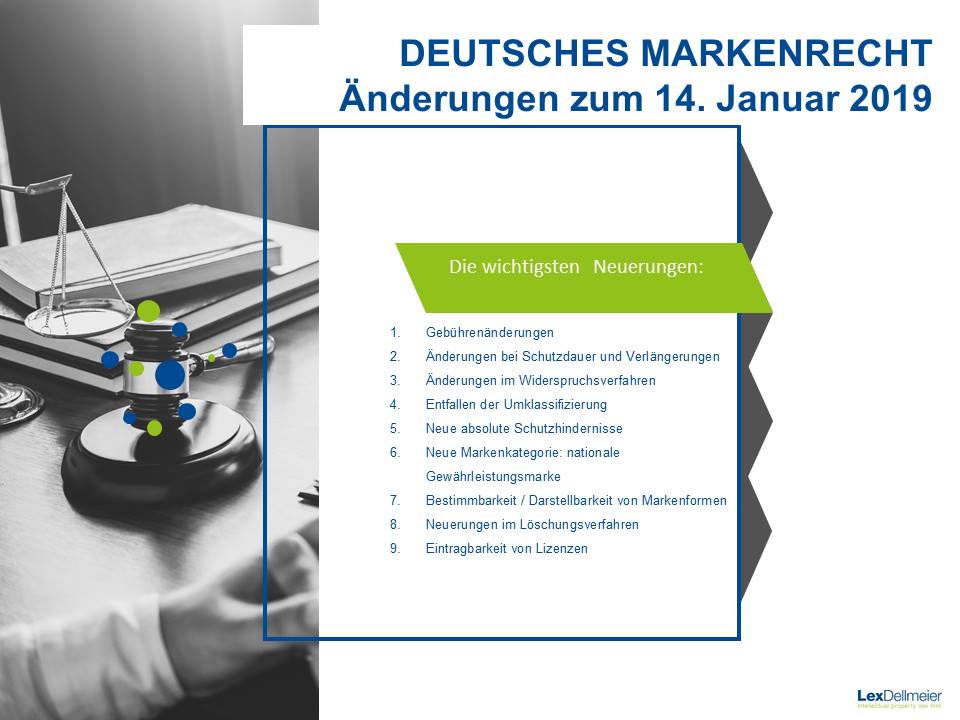
We would like to provide an overview of the most significant changes.
- Term of protection and due date of renewals
The term of protection for German trademarks registered on or after 14 January 2019 will expire ten years after the filing date. For German trademarks which have been registered before 14 January 2019, the expiry of the term of protection remains ten years after the end of the month in which the trademark was applied for. The GPTO intends to inform trademark owners (or their local German representatives) eight (8) months prior to the expiry of the term of protection.
Due to a change in the Patent Costs Act (Patentkostengesetz), the due date for the payment of renewals has changed. However, this change is not applicable to registered German trademarks whose term of protection currently expires on or after 1 February 2020. In those cases, the expiry of the term of protection and the due date for the payment of the renewals are identical. For all other German trademarks, the expiry of the term of protection and the due date of payment of the renewal fee will differ: in these cases, the renewal fee becomes due six months prior to the expiry of the term of protection. It can be paid without surcharge until the expiration date and with surcharge within an additional period of six months after the end of the term of protection.
- Amendments in the opposition proceedings
According to the previous version of the German Trademark Act, filing an opposition was possible on the basis of one opposing mark, only. If an owner of several prior rights intended to base his opposition on a multitude of different trademarks, he had to file a single opposition for each opposition mark and pay the full opposition fee for each formal opposition. As of 14 January 2019, the holder of several earlier rights is able to assert several or all of prior rights by lodging one single opposition. Also, the opposition fee is brought into line with this new system and the increased effort involved: the official fee for lodging an opposition against a trademark based on one prior trademark is now EUR 250,00, for each additional opposition mark it is EUR 50,00 (previously: EUR 120,00 official fee per opposition).
At the same time, the opposition options will be expanded: For example, protected geographical indications and protected designations of origin will constitute new, additional grounds for opposition.
Furthermore, the new German Trademark Act provides kind of a “cooling-off”-period. In order to facilitate negotiations between the parties to the proceedings, a period of at least two months will be granted at their joint request to reach an amicable settlement. This period can be extended by a joint request by both parties. Please note that the German “cooling-off” will likely be handled a bit more liberal than at the EUIPO.
Further important changes were made with respect to the time period for which proof of use of a trademark on which an opposition had been based had to be furnished upon request of the owner of the opposed trademark. Previously, there were two time periods which were relevant in this respect: five years before the date of publication of the registration of the challenged trademark on the one hand and, on the other hand, the so-called “moving period of use” which was five years preceding the decision on the opposition. This second time period – the “moving period of use” – has now been deleted. The first period has been changed and, as a consequence, the only time period which is now relevant is five years before the filing date or the priority date of the challenged trademark.
In addition, proof of use is required instead of making a plausible case, but this can also be provided by means of an affirmation in lieu of an oath, which has so far also been the main means of making a plausible case.
In addition, the grace period for use now commences on the date when no further opposition can be filed against the registration of a German trademark. This is either the day after expiry of the opposition period or the date on which the decision which concluded the opposition proceedings becomes final or the withdrawal of the (last) opposition. According to the previous German Trademark Act, the grace period of use began upon publication of the registration or – if an opposition was filed against the registration – at the date when the opposition proceedings were concluded. The beginning and the end of the grace period for use will now be recorded and published in the register of the GPTO.
- Abolition of re-classification
If the division into classes of goods and services is altered after the filing date, the classification will not be adjusted upon renewal of a trademark, neither ex officio nor upon request of the trademark owner. This will lead to certain insecurities in the everyday work of trademark practitioners, in particular when conducting trademark availability searches. It could happen that goods or services filed years ago fall into one class which due to changes in the Nice Classification will in the future fall into another class. Discrepancies and non-findings of marks may happen.
- New absolute grounds for refusal
Protected geographical indications and protected designations of origin, in particular for foodstuffs, wines and spirits protected under national or European legislation or agreements, are now also to be considered as absolute grounds for refusal during the German application procedure or invalidity proceedings. The same applies to protected traditional terms for wine, traditional specialities guaranteed with regard to foodstuffs and protected variety denominations.
- National certification mark
A new trademark category has been implemented into the national German trademark system: the certification mark. The certification mark focuses on the function of the mark to guarantee specific features of the protected goods/services. Hence, the function of the trademark as an indication of origin fades into the background.
A certification mark must be designated as such when the application is filed. It must be capable of distinguishing goods or services which are certified by the trademark owner in respect of material, mode of manufacture, quality, accuracy or other characteristics of goods or performance of services, from goods and services which are not certified accordingly. The certifying character of the mark must result from the representation of the sign. The trademark owner must provide information – in particular on the guaranteed characteristics of the goods, the conditions of use and the testing and monitoring measures – in the mandatory regulations governing use of the trade mark.
- Determinability of trademark
Whereas trademarks in the register previously had to be “capable of being represented graphically”, it now suffices if they can be clearly and precisely “determined”. This change in representation aims to meet the market needs for modern and “new” trademark types and also takes into account the technical possibilities of representing a trademark in electronic registers. Accordingly, for example, sound marks, multimedia marks, holograms and other types of trademarks in suitable electronic formats may also be registered as trademarks, provided there are no absolute grounds for refusal.
- Changes in the cancellation proceedings
Since 14 January 2019, cancellation proceedings have been renamed to "revocation proceedings" or "invalidity proceedings". Expectedly from 1 May 2020 onwards, it will be possible to claim relative grounds for refusal (earlier rights) in official invalidity proceedings in addition to absolute grounds for refusal (the latter has always been possible). However, there will still be the possibility to call an ordinary civil court and file a cancellation action against a younger trademark based on prior rights. It will most likely be a tactical question whether to go to the GPTO or a civil court. Note: We have specialized IP courts in Germany with at least three (3) judges on the bench.
- Licenses
Licences can now be entered in the GPTO Register upon request. The entry includes information on the licensee, the type of licence and restrictions, if any. The registration, amendment and cancellation of a licence in the register is subject to an official fee amounting to EUR 50,00. The holder of an exclusive licence himself may also bring an action before the ordinary courts for trademark infringement if the proprietor of the trademark himself does not file an action within a reasonable period of time after being formally requested to do so. In addition, upon request, trade mark applicants and proprietors may have an entry included in the register about a non-binding declaration of their willingness to license or sell/transfer their trademark. The entry is free of charge and this willingness may be withdrawn at any time.
For more information, please note that we have conducted a webinar (in German) on the changes. In case of interest and in order to access the webinar, please contact us via email at: info@lexdellmeier.com.